Executive Summary
Global Crisis Index Intelligence Briefing: As of May 2026, worldwide instability continues to rise across multiple sectors including war, disease activity, severe weather, food stress, and humanitarian displacement.
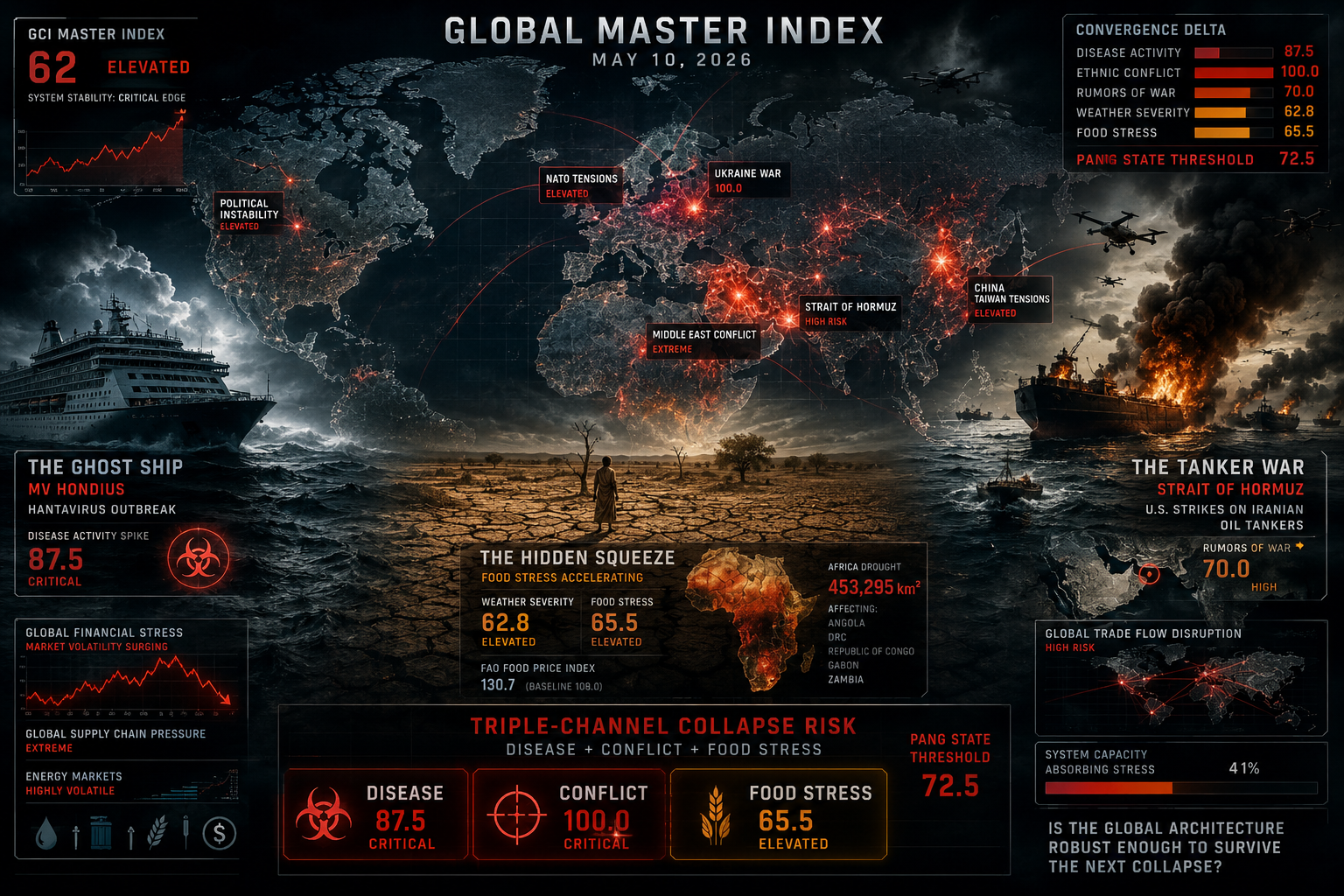
As of May 18, 2026, the Global Crisis Index (GCI) stands at 63/100 , indicating an Elevated state of global volatility. While the master index remains below the active convergence threshold, specific sectors have reached “Critical” and “Pang State” levels, signaling severe localized instability. The primary drivers of this elevation are Ethnic Conflict (97.7) , Disease Activity (87.5) , and Weather Severity (82.0) .The most urgent developments include a World Health Organization (WHO) declaration of a Global Health Emergency regarding an Ebola outbreak in Central Africa and escalating military tensions between the United States, Israel, and Iran. Furthermore, the convergence of atmospheric events and agricultural output is driving food prices significantly above historical baselines.
Sector Risk Assessment
Category,Index Score,Status,Key Drivers
Ethnic Conflict,97.7,Pang State,”Middle East tensions, Ukraine front-line shifts.”
Disease Activity,87.5,Critical,”Ebola PHEIC (DRC/Uganda), Hantavirus in Canada.”
Weather Severity,82.0,Critical,Regional droughts in Africa and South America.
Food Stress,65.5,Elevated,”FAO price spikes, supply blockades.”
War & Conflict,50.0,Monitoring,”Iran war preparations, drone warfare evolution.”
Seismic Activity,50.0,Monitoring,13 events (M4.5+) in 24 hours.
Economic Stress,49.1,Monitoring,CBOE VIX at 18.97.
Humanitarian Impact,48.9,Monitoring,Displacement in Mozambique and South Sudan.
Primary Drivers and Thematic Analysis
1. Global Health Emergencies (Disease Activity: 87.5)
The health sector has reached a critical threshold, primarily driven by a significant Ebola outbreak in Central Africa.
- Ebola PHEIC: The WHO has officially declared the Ebola outbreak in the Democratic Republic of the Congo (DRC) and Uganda a Public Health Emergency of International Concern (PHEIC) .
- The Pathogen: The outbreak is caused by the Bundibugyo virus , a rare strain for which there is currently no vaccine.
- Response: The International Rescue Committee (IRC) has launched emergency operations as the virus spreads across eastern DRC and Uganda.
- Hantavirus: Canada confirmed its first Hantavirus case. While the WHO currently evaluates the global risk as “low,” the case contributes to the elevated disease index.
- Regional Success: In contrast to the Central African crisis, the Indian government confirmed that no fresh cases of Ebola have been reported in India since 2014.
2. Geopolitical Volatility (War & Conflict: 50.0)
While the index for War and Conflict is currently in the “Monitoring” phase, intelligence suggests a rapid escalation in the Middle East and continued attrition in Eastern Europe.
- Iran-Israel Confrontation: Reports indicate that the US and Israel are preparing for possible new strikes on Iran as early as next week. Political executions within Iran are reportedly surging, and Hezbollah is employing evolving drone tactics against Israeli targets. Former US President Trump has stated that the “clock is ticking” for Iran as peace deals remain elusive.
- Ukraine Conflict: The front lines in Ukraine are described as “kill-zones” due to the introduction of new weapons systems. Large-scale Ukrainian drone strikes have recently targeted Russian territory, resulting in at least four fatalities.
- Diplomatic Alignments: Amidst these tensions, Indian Prime Minister Modi secured 17 strategic pacts during a visit to the Netherlands, signaling shifting international alliances.
3. Resource and Environmental Stress (Weather: 82.0 / Food: 65.5)
Environmental factors are increasingly impacting global food security through “atmospheric compression” of agricultural output.
- Food Pricing: The FAO Food Price Index has reached 130.7 , significantly higher than the 108.0 baseline (2014-16=100).
- Drought Conditions: Global Disaster Alert and Coordination System (GDACS) orange alerts are active for medium-impact agricultural droughts in two major regions:
- Central/Southern Africa: Angola, DRC, Republic of Congo, Gabon, and Zambia (covering 368,993 km²).
- South America: Argentina and Uruguay (covering 104,014 km²).
4. Humanitarian Impact and Displacement
Active military operations and environmental stressors are driving significant population movements.
- Mozambique: Flash updates indicate new displacement in Cabo Delgado as of mid-May 2026.
- WFP Monitoring: The World Food Programme has issued country briefs for Tanzania, Zimbabwe, South Sudan, and Timor-Leste, highlighting ongoing humanitarian needs in those regions.
Convergence Delta Analysis
The GCI tracks “Pang State” convergence—where multiple crisis channels intersect to create compounded risk.
- Pang State Threshold: Currently, three channels simultaneously exceed the 72.5 threshold: Ethnic Conflict , Disease , and Weather . This meeting of criteria signals a high risk of systemic instability.
- Conflict-Humanitarian Intersection: Verified data confirms that active military operations are directly generating civilian displacement, particularly in the Middle East and Mozambique.
- Weather-Food Intersection: Atmospheric events and severe droughts are currently compressing agricultural output, leading to the observed spikes in the FAO Food Price Index.
Critical Intelligence Quotes
“This may be the last time you hear my voice.” — Reported from Iran amid a surge in political executions since the start of the war.“Rare Ebola strain with no vaccine spreads across eastern DRC and Uganda.” — ReliefWeb/IRC Intelligence.“Weather Severity and Food Stress channels are intersecting — atmospheric events are compressing agricultural output.” — GCI Convergence Analysis.
I’m Wayne – and that’s our world today.