When Stability Metrics Conceal Structural Global Fragility.
1. The Hook: A World in “Elevated” Equilibrium
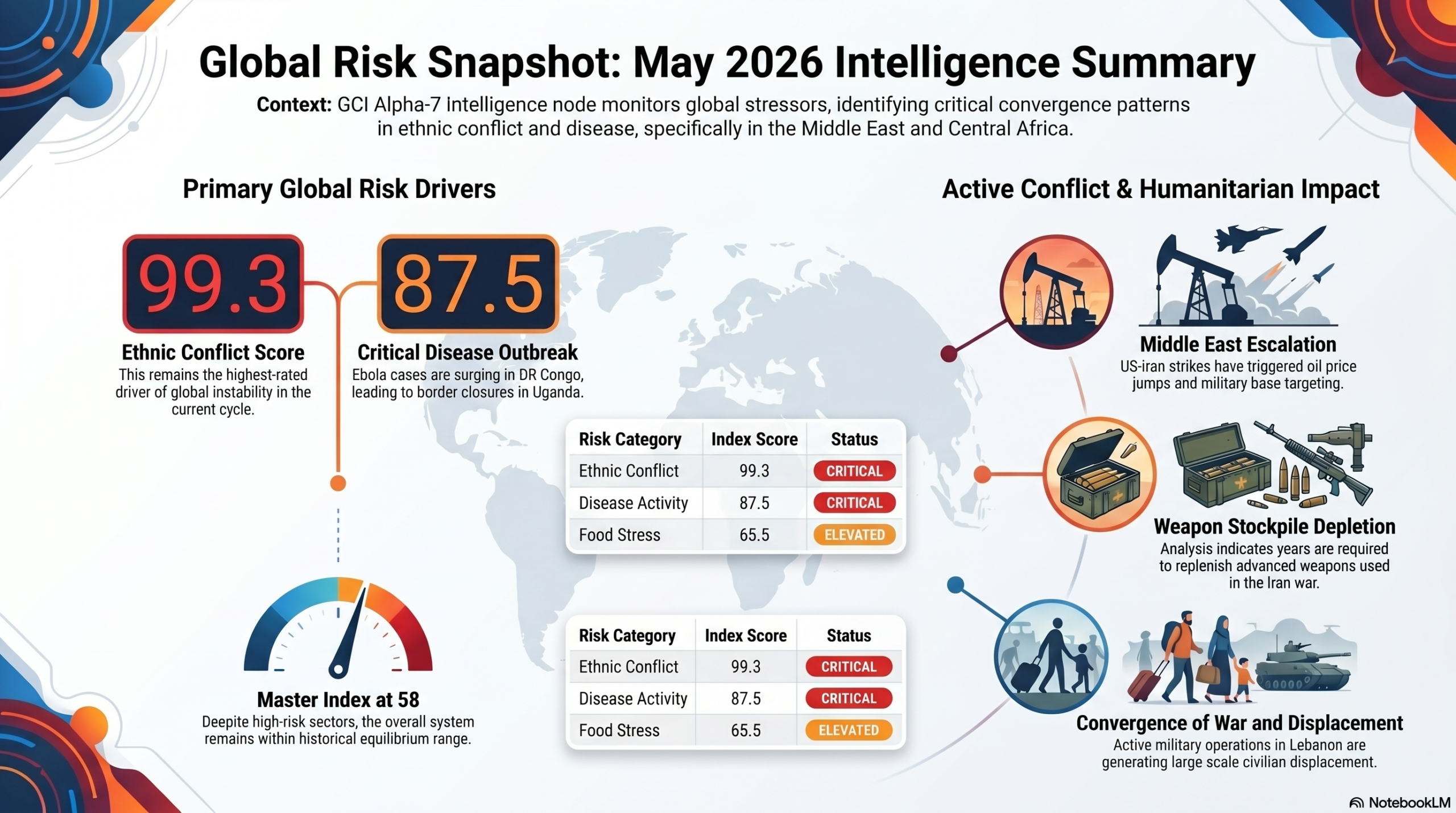
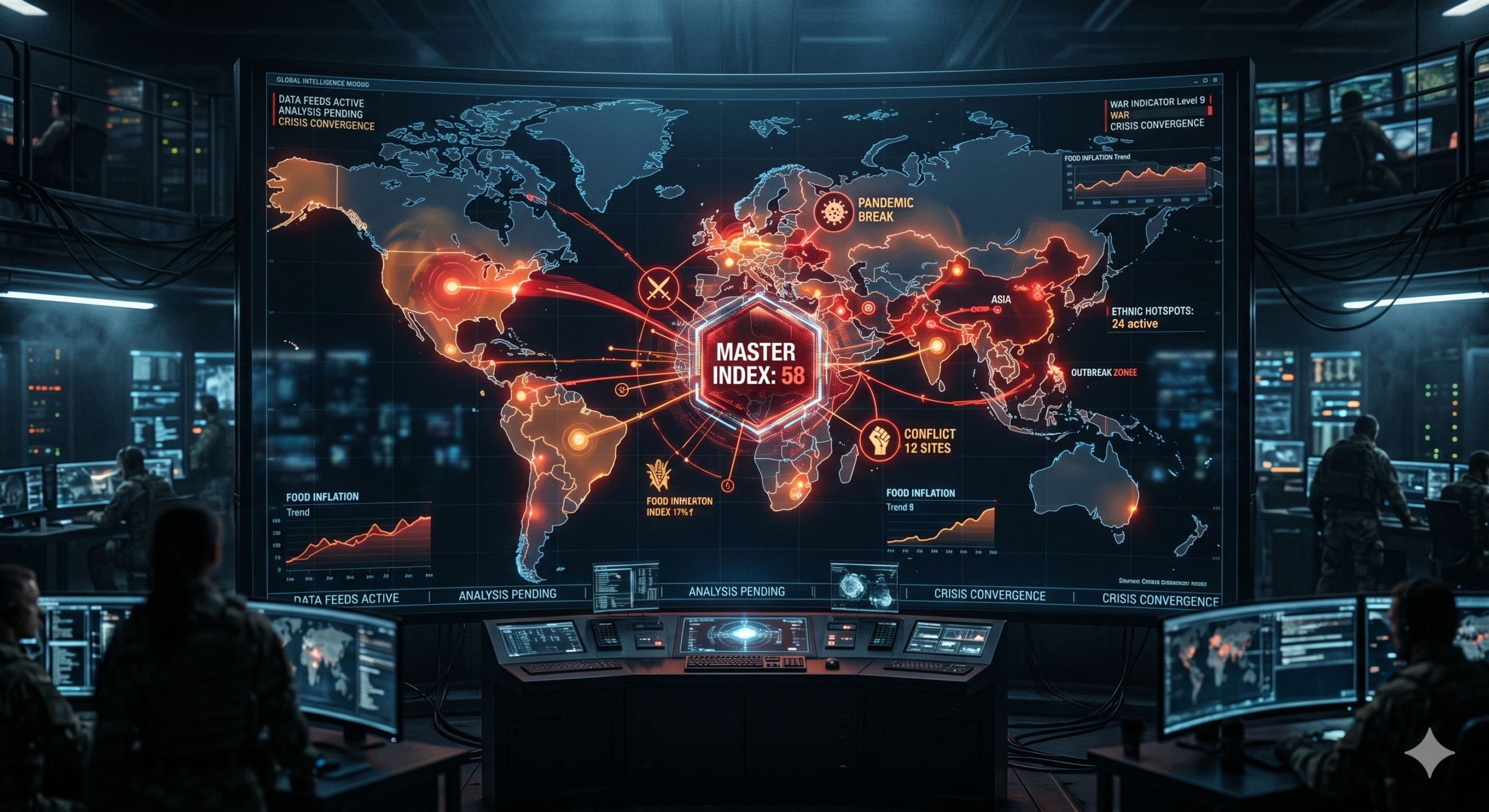
As of May 14, 2026, the global state of stability rests at a deceptive crossroads. According to the latest GCI Watchman Report, the “Master Index”—a holistic measure of global pressure—is currently sitting at 58 out of 100. In technical terms, this is “Monitoring” status, an elevated equilibrium that suggests a system holding its breath.But have you noticed the subtle shifts in the global landscape? While the headline index suggests a baseline level of stability, the underlying “Convergence Delta” is the silent engine of this era, whispering that our stability is an optical illusion. The Convergence Delta isn’t just a list of problems; it is a technical measure of how stressors—specifically ethnic conflict, disease, and the psychological weight of war—are beginning to amplify one another. It is a calm that feels like the prelude to a storm, where the system is balanced not because the threats have diminished, but because they have reached a momentary, high-tension stasis.
2. The Return of Rare Pathogens: Disease at a Critical Threshold
While the overall index remains moderate, the sub-score for “Disease Activity” has spiked to a Critical level of 80.0 . This is no longer a theoretical warning; it is driven by the re-emergence of high-impact pathogens in unexpected corridors. In Kansas, three individuals are currently under observation at KU Hospital following possible exposure to hantavirus, while Measles has re-emerged in Osage County with a confirmed exposure site at a Topeka church.The most alarming indicator, however, comes from Europe, where the containment efficacy of modern medicine is being tested to its limit:”Critically ill French hantavirus patient is on an artificial lung as outbreak grows to 11.” — PBS NewsHour, May 13, 2026A health score of 80.0 is significant because it indicates that localized outbreaks are no longer isolated incidents. When rare diseases appear simultaneously in rural American heartlands and metropolitan France, it signals a broader systemic vulnerability. We are seeing a breakdown in the standard protocols of containment, suggesting that our global public health infrastructure is fraying at the edges.
3. The “Iran War” Surcharge: Why Your Next Flight Is More Expensive
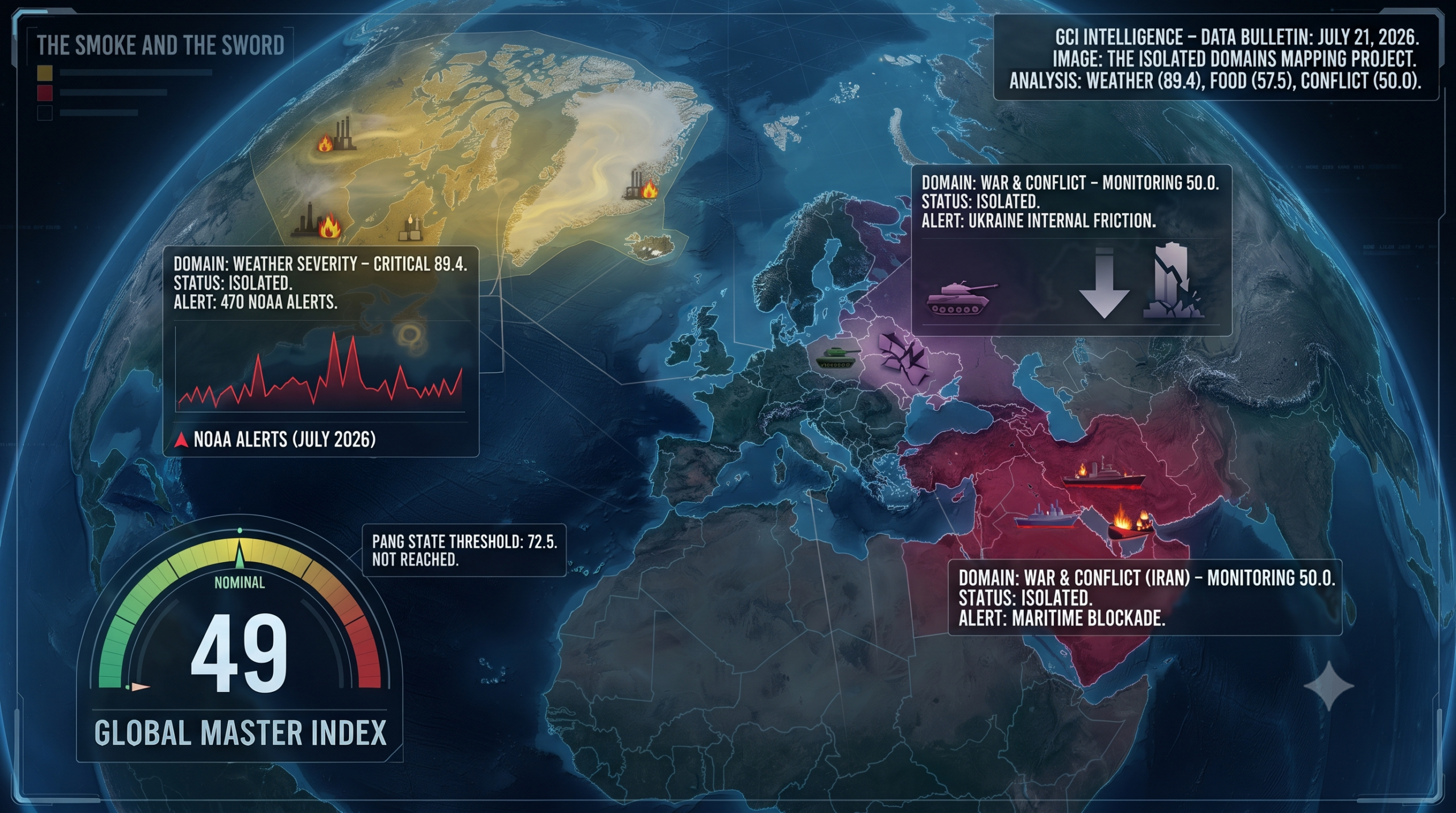
The “War & Conflict” score is currently at 50.0, but this figure masks the true psychological and economic weight of the era. The report lists “Rumors of War” at a staggering 70.0 , identifying it as a primary driver of global instability. This reveals a critical foresight insight: the “Iran War” is no longer a temporary spike in the news cycle; it has become a structural feature of the global economy.The economic ripples are manifesting in three distinct “foresight” vectors:
- The Logistics Choke: The ongoing standoff in the Strait of Hormuz keeps energy markets on a knife-edge, ensuring that shipping costs remain volatile.
- The Debt Trap: Geopolitical fear is fueling a mass selloff in the bond market, heightening inflation anxieties and trapping emerging markets in a cycle of high-interest debt.
- The Mobility Tax: The necessity of rerouting global transit to avoid conflict zones has reached the consumer level.”Higher Europe air fares inevitable due to Iran war, says industry lead.” — BBC, May 13, 2026
4. The Silent Surge: FAO Food Prices Break the Baseline
While “Food Stress” is currently rated as “Elevated” (65.5), the raw data suggests a more aggressive, long-term trend. The FAO Food Price Index has reached 130.7 , a stark increase against the historical baseline of 108.0. This represents a more than 20% surge in the cost of basic commodities, a price level that historically correlates with social unrest.This price pressure is compounded by a massive environmental crisis. “Orange” drought alerts are currently active across two major clusters: the first spanning Angola, the Democratic Republic of Congo, the Republic of Congo, Gabon, and Zambia (covering 368,993 km²), and the second in Madagascar (covering 281,056 km²). With over 650,000 square kilometers of agricultural land under severe stress, the disconnect between the “Monitoring” status of the index and the reality of 130.7 price levels is clear. These sustained droughts suggest that current price spikes are the new, expensive baseline for global survival.
5. The New Guard: A Shift in Financial Leadership
In the midst of this volatility, the United States has signaled a major shift in economic policy. The Senate has confirmed Kevin Warsh as the new chair of the Federal Reserve, replacing Jerome Powell.This change in leadership is a pivotal moment for foresight analysis. Warsh is not arriving to manage a standard recovery; he is taking the helm of a “War Economy” baseline. There is a profound tension between market signals and geopolitical reality: the VIX (CBOE Volatility Index) sits at a relatively complacent 17.91 , yet the “Rumors of War” score is at 70.0 . This suggests that while financial markets are attempting to price in a “return to normal,” the underlying geopolitical drivers are pulling in the opposite direction. Warsh’s first challenge will be navigating this gap between market complacency and the inflationary pressures of an active conflict.
6. The “Pang State”: When Ethnic Conflict and Disease Collide
The May 14 report highlights a technical phenomenon known as the “Pang State.” This occurs when two high-stress categories—in this case, Ethnic Conflict (scoring a massive 93.7) and Disease (80.0)—both exceed the 72.5 threshold simultaneously.This “dual-vector stress” is the most dangerous configuration in the report. A score of 93.7 in Ethnic Conflict represents a near-total breakdown of social cohesion and trust. When this is paired with a Critical Disease score of 80.0, the danger is exponential: a fractured society cannot coordinate a unified medical response. While the report notes there is no “birth pang convergence” yet—meaning these forces haven’t yet fused into a single, uncontrollable catastrophe—the simultaneous pressure creates a fragile environment where the margin for error has effectively vanished.
7. Conclusion: The Equilibrium Question
The GCI Watchman Report concludes that the global system remains within its “historical equilibrium range.” Despite the critical scores in disease and the mounting structural costs of the Iran war, a Master Index of 58 suggests a world that is still functioning within known parameters. However, this leads us to a fundamental question: Is a Master Index of 58 truly a sign of stability? Or have we simply become desensitized to a world where 20% food inflation, critical viral outbreaks, and the permanent shadow of regional war are the new “normal”? As we watch the Convergence Delta, it becomes clear that the “Elevated” status of today may simply be the deceptive baseline of tomorrow.
I’m Wayne – and that’s our world today!