Executive Summary
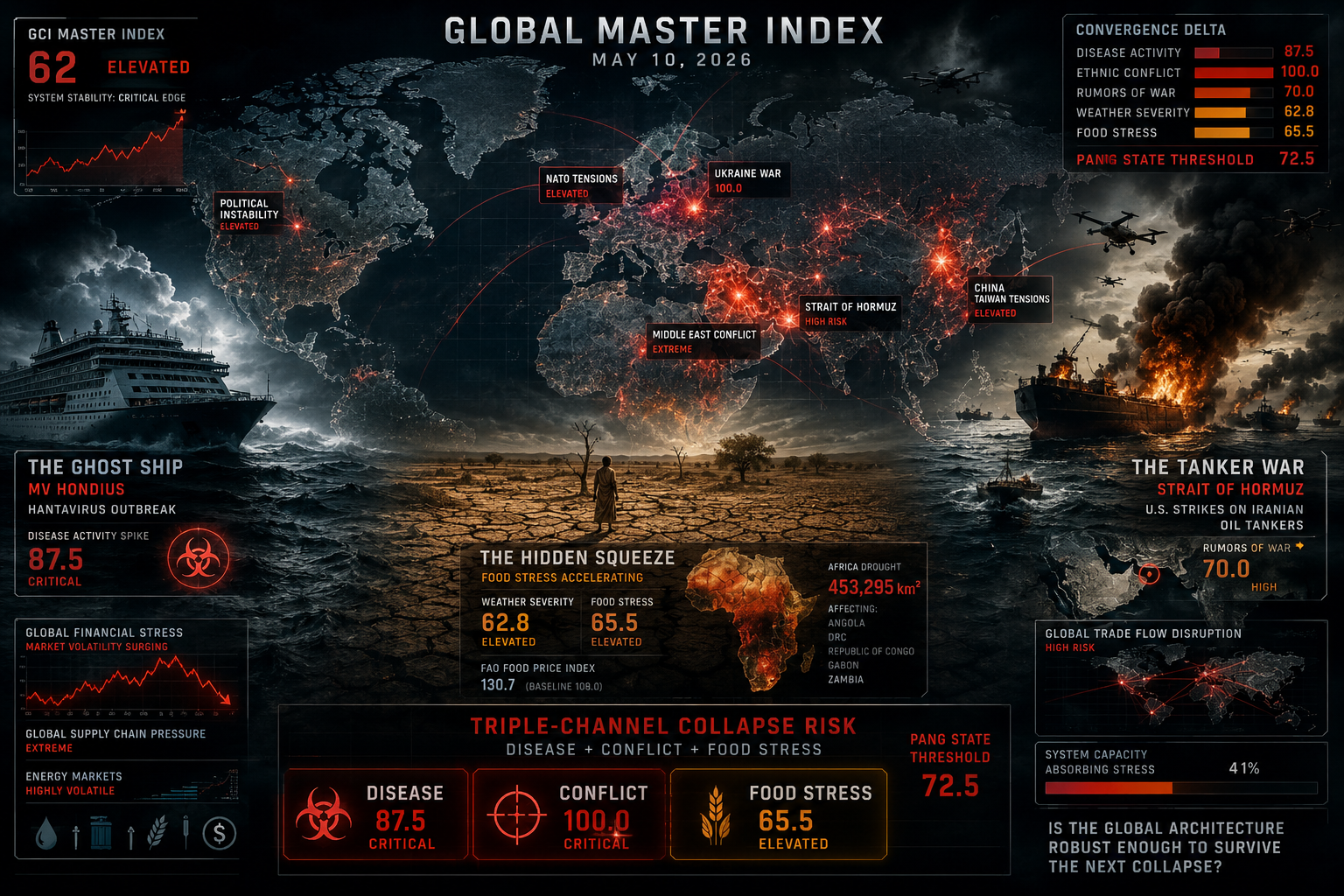
As of May 13, 2026, the Global Crisis Index (GCI) Master Index stands at 61 , categorized as Elevated . While this remains below the threshold for full active convergence, the global landscape is defined by critical stressors in specific sectors, most notably in Disease Activity (87.5) and Ethnic Conflict (89.3) . These two categories have reached “Pang State” (scores ≥72.5), indicating a dual-vector stress environment.The primary drivers of global instability currently include ethnic conflict, disease outbreaks, and persistent “rumors of war.” Significant volatility is observed in the Middle East, where Iranian military drills and escalating conflict in Southern Lebanon are impacting global supply chains, specifically regarding fuel and specialized manufacturing materials. Simultaneously, the humanitarian sector is managing the intersection of active military operations and civilian displacement, alongside significant agricultural droughts in Africa and South America.
Primary Crisis Drivers and Indicators
The GCI identifies three primary vectors currently driving the global risk profile:| Driver | Index Score | Status || —— | —— | —— || Ethnic Conflict | 89.3 | Pang State || Disease Activity | 87.5 | Critical / Pang State || Rumors of War | 70.0 | Elevated |
Convergence Delta
The “Convergence Delta” analysis indicates that while four categories (Disease, Humanitarian, War, and Weather) have verified activity, they are largely operating in isolated domains. However, a “moderate convergence” is noted between War & Conflict and Humanitarian Impact , as active military operations are directly generating civilian displacement. The criteria for a 3-channel simultaneous Pang State—which would trigger a full convergence alert—have not yet been met.
Detailed Thematic Analysis
1. War and Geopolitical Conflict
The conflict landscape is dominated by the deteriorating situation in the Middle East and ongoing developments in Ukraine.
- Iran and the Middle East: Iranian Revolutionary Guards are conducting military drills in the capital as ceasefires teeter. This conflict has moved beyond kinetic warfare into significant economic disruption. Ship operators report fears of fuel shortages, and snack manufacturers have been forced to use black-and-white packaging due to war-related disruptions in ink supplies.
- Domestic Political Pressure (U.S.): Tensions are rising regarding the cost of the Iran conflict. U.S. Senator Murray has characterized the Pentagon’s war cost estimates as “suspiciously low,” while President Trump has stated, “I don’t think about Americans’ financial situation” when negotiating with Iran.
- Lebanon: A “bloody escalation” in Southern Lebanon has resulted in casualties among army personnel and paramedics, with qualitative resistance operations targeting occupation forces.
- Ukraine: Internal stability is being tested by an escalating corruption probe involving President Zelensky’s former chief of staff. Concurrently, the EU is doubling support for efforts to repatriate Ukrainian children.
2. Disease Activity and Health Emergencies
The Health sector is currently at a Critical level (87.5).
- Hantavirus Incident: A Dutch hospital was forced to quarantine staff following a protocol breach involving Hantavirus. While the UN health agency currently reports no signs of a larger outbreak, the incident has contributed to the elevated risk score.
- Legislative and Insurance Shifts: A Washington court ruling may soon require health insurance to cover GLP-1 weight-loss drugs, signaling a shift in healthcare policy and economic obligations.
3. Economic and Food Stress
Economic indicators remain in the Monitoring phase, but underlying data suggests mounting pressure.
- Food Pricing: The FAO Food Price Index has reached 130.7 , significantly higher than the baseline of 108.0 (2014-16 average). Despite this, no new food-specific headlines were verified in the current cycle.
- Market Volatility: The CBOE VIX sits at 17.88 , which is slightly below the historical baseline of 19.5, indicating that market fear has not yet reached crisis levels despite geopolitical tensions.
4. Humanitarian Impact and Weather Severity
Environmental factors are exacerbating humanitarian needs in several regions.
- Agricultural Droughts: GDACS has issued Orange Alerts for medium-impact agricultural droughts across two major regions:
- Africa: Angola, Democratic Republic of Congo, Republic of Congo, Gabon, and Zambia (covering 368,993 km²).
- South America: Argentina and Uruguay (covering 104,014 km²).
- Active Weather Events: Sri Lanka continues to manage the aftermath of Cyclone Ditwah (Situation Report No. 13). In the United States, NOAA has 306 active alerts, including Red Flag Warnings in the Deerlodge and Western Beaverhead National Forests and High Wind Warnings in Oregon.
- Regional Aid: The World Food Programme (WFP) issued May 2026 briefs for Djibouti, Kenya, and Tajikistan, highlighting ongoing food security efforts.
5. Seismic Activity
Seismic activity is currently categorized as Monitoring (49.3) . In the 24-hour period ending May 13, 2026, the USGS recorded 13 events of magnitude 4.5 or greater, which aligns closely with the historical baseline of 13.2 events per day.
I’m Wayne – and that’s our world today!