Executive Summary
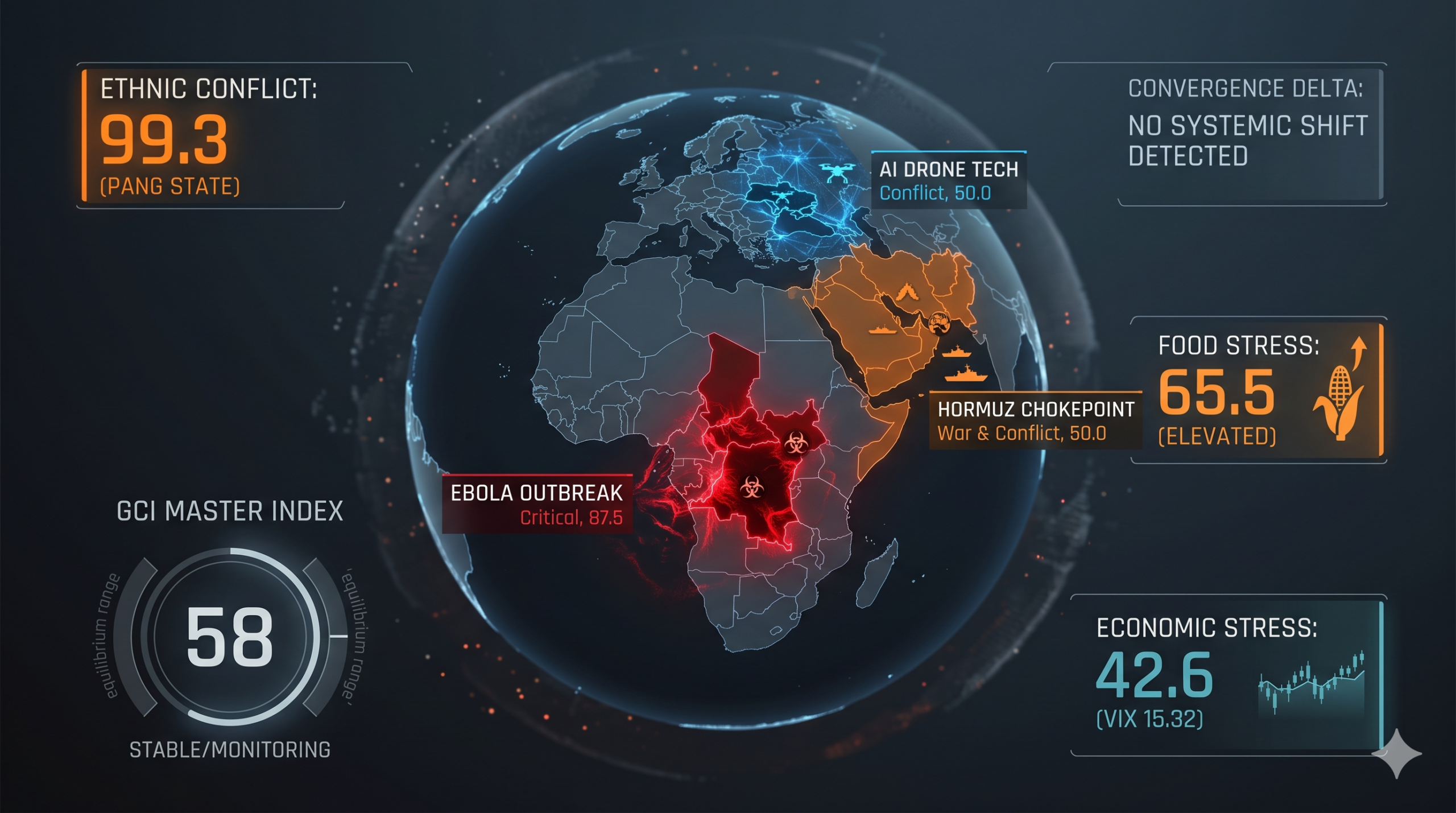
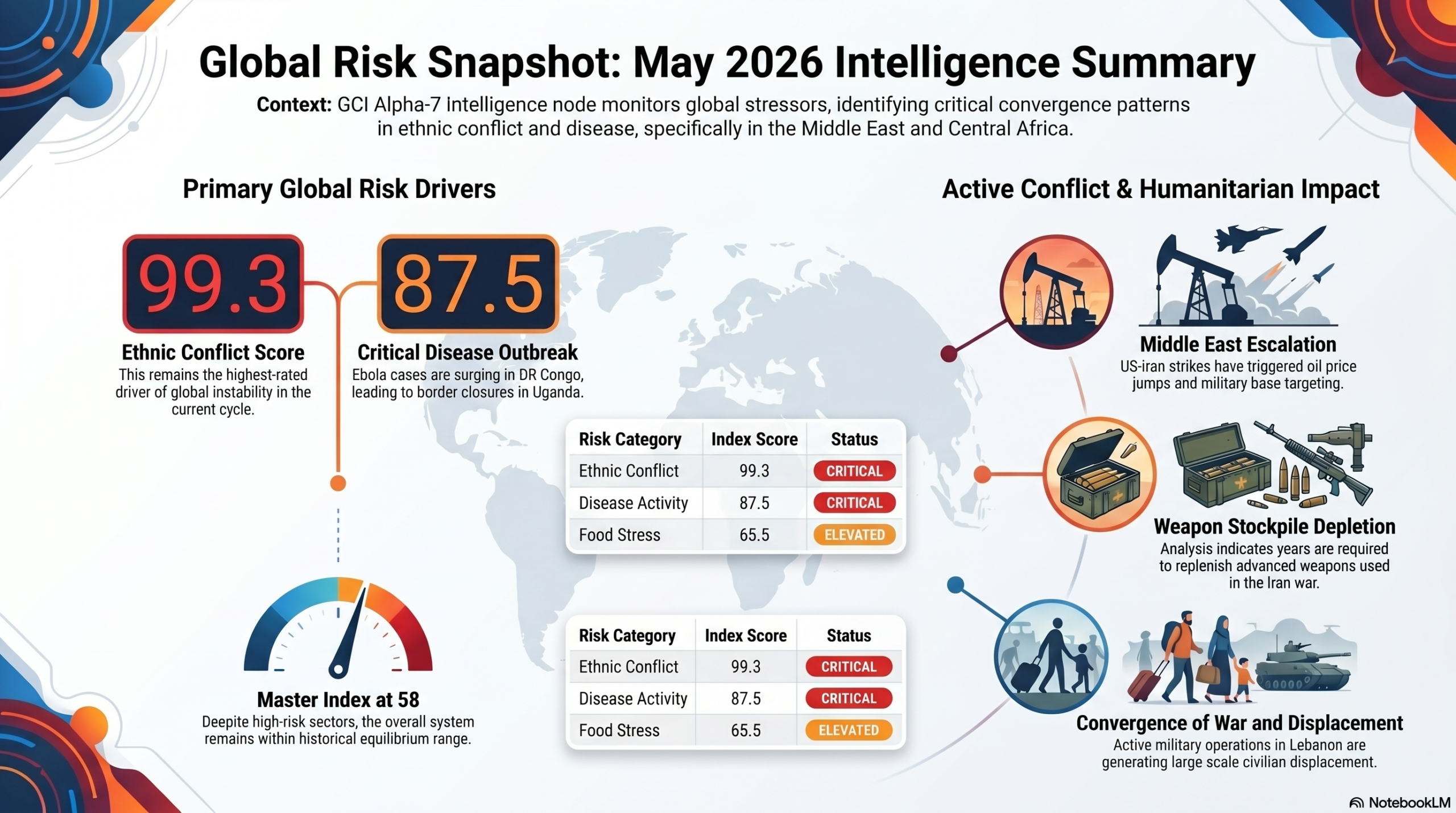
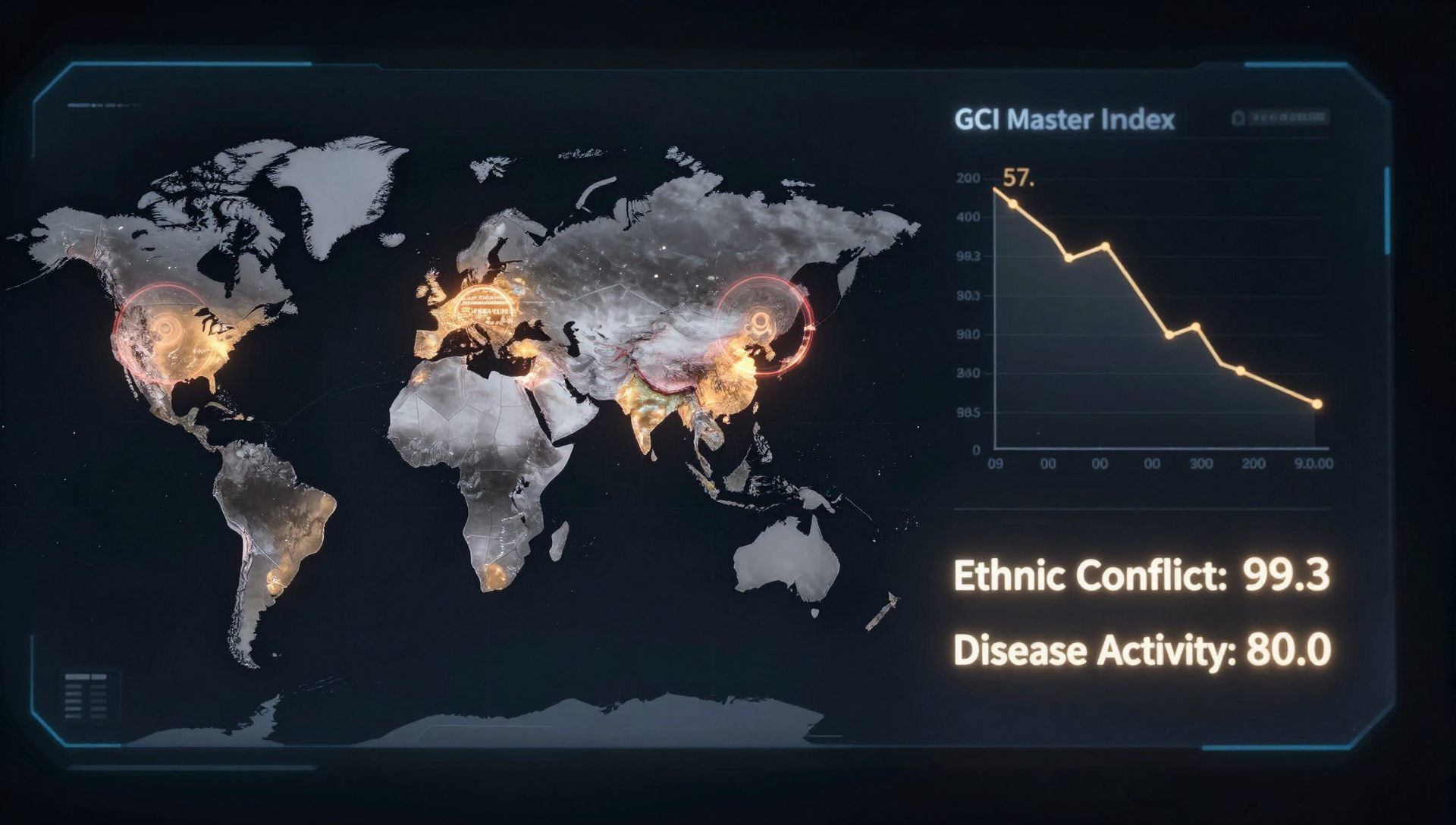
As of June 2, 2026, the GCI Master Index remains at 57 , indicating the global system is within a historical equilibrium range. However, this stability is underpinned by extreme volatility in specific sectors. The primary drivers of global instability are Ethnic Conflict (99.3) , Disease Activity (80.0) , and Rumors of War (70.0) .The most critical developments involve the collapse of ceasefire expectations in the Middle East, a “Critical” rated Ebola outbreak in the Democratic Republic of Congo (DRC) with nearly 300 cases, and persistent ethnic tensions that have remained at near-maximum levels throughout the reporting period. While cross-category amplification remains below active convergence thresholds, the intersection of military operations and humanitarian displacement suggests a state of moderate convergence.
Global Risk Metrics Overview (May 26 – June 2, 2026)
The following table summarizes the fluctuations in key risk indicators leading up to the current reporting period.
| Date | Master Index | Ethnic Conflict | Disease | War & Conflict | Food Stress |
|---|---|---|---|---|---|
| 2026-05-26 | 59 | 99 | 80 | 50 | 66 |
| 2026-05-28 | 58 | 99 | 88 | 50 | 66 |
| 2026-05-31 | 58 | 99 | 88 | 50 | 66 |
| 2026-06-01 | 61 | 99 | 88 | 50 | 66 |
| 2026-06-02 | 57 | 99.3 | 80.0 | 50.0 | 65.5 |
Note: The Master Index peaked at 63 on May 27 before stabilizing at 57.
Primary Risk Drivers and Detailed Analysis
1. War and Conflict (Score: 50.0 – Monitoring)
The prevailing theme in international security is the failure of diplomatic efforts to secure lasting peace in the Middle East and Eastern Europe.
- Middle East Instability: Intelligence reports indicate that the “illusion of ceasefire is over.” Despite initial reports of Israel and Hezbollah accepting a U.S.-mediated partial ceasefire, clashes continue in Lebanon.
- Iran-Washington Relations: Iran has suspended all negotiations with Washington, stipulating that a total cessation of “aggression against Lebanon” is required to resume dialogue. Satellite imagery has confirmed that Iranian attacks have damaged 20 U.S. military sites since the conflict began.
- Ukraine Conflict: A massive Russian attack on various cities resulted in at least 13 civilian fatalities.
- Domestic Defense Incidents: In South Korea, politicians have demanded a probe following a blast at a Hanwha Aerospace site, highlighting vulnerabilities in defense infrastructure.
2. Disease Activity (Score: 80.0 – Critical)
Disease remains the most volatile active threat, classified as “Critical” despite a slight numerical decrease from a peak of 88.0.
- Ebola Outbreak: The Democratic Republic of Congo is facing a significant outbreak with cases nearing 300. While some medical workers have recovered, three different vaccines are currently in rapid development to stem further spread.
- Macro-Impacts: Analysts suggest that modern travel and ongoing wars are “rewiring supply chains,” leading to discussions regarding the potential “end of globalization” as health emergencies and trade conflicts intersect.
- Monitoring: Potential Ebola cases in Brazil were recently ruled out after negative test results, preventing a transcontinental escalation.
3. Food Stress (Score: 65.5 – Elevated)
Food insecurity is driven by price spikes and supply blockades.
- Price Indices: The FAO Food Price Index has reached 130.7 , significantly higher than the baseline of 108.0 (base year 2014-16).
- Supply Chain Disruptions: Elevated levels of war and trade conflicts continue to pressure global food distribution networks.
4. Ethnic Conflict and Humanitarian Impact
Ethnic conflict remains the highest-rated driver at 99.3 , currently operating in a “Pang State.”
- Myanmar: The Burma Army has conducted shelling and air strikes in the Taw Oo District (Htaw Ta Htoo Township), injuring children and damaging civilian infrastructure, leading to further internal displacement.
- Madagascar: A medium-impact agricultural drought is affecting over 311,000 km², creating significant humanitarian pressure.
Secondary Indicators
Economic and Market Stress
- Volatility: The CBOE VIX stands at 16.15 , which is below the historical baseline of 19.5, suggesting that financial markets have not yet fully priced in the geopolitical instability observed in the Middle East and Ukraine.
- Status: Monitoring (44.1).
Environmental Severity
- Weather: NOAA has issued 289 active alerts in the U.S., including severe flood warnings for Kingman, Reno, and Ottawa, Kansas.
- Seismic Activity: Currently stable at 38.3. There were 10 events of M4.5+ in the last 24 hours, which is below the historical daily average of 13.2.
Convergence Delta
The June 2nd analysis identifies a “Moderate Convergence” pattern. While Ethnic Conflict and Disease are both in a “Pang State” (Score ≥ 72.5), they are currently operating in isolated domains without confirmed cross-category amplification.However, a verified intersection exists between War & Conflict and Humanitarian Impact . Active military operations in multiple theaters (Lebanon, Ukraine, Myanmar) are directly generating civilian displacement and infrastructure damage, suggesting that these vectors are beginning to merge. The Master Index remains at 57, indicating no “birth pang convergence” (systemic collapse pattern) has been detected in this cycle.
I’m Wayne – and that’s our world today!