Executive Summary
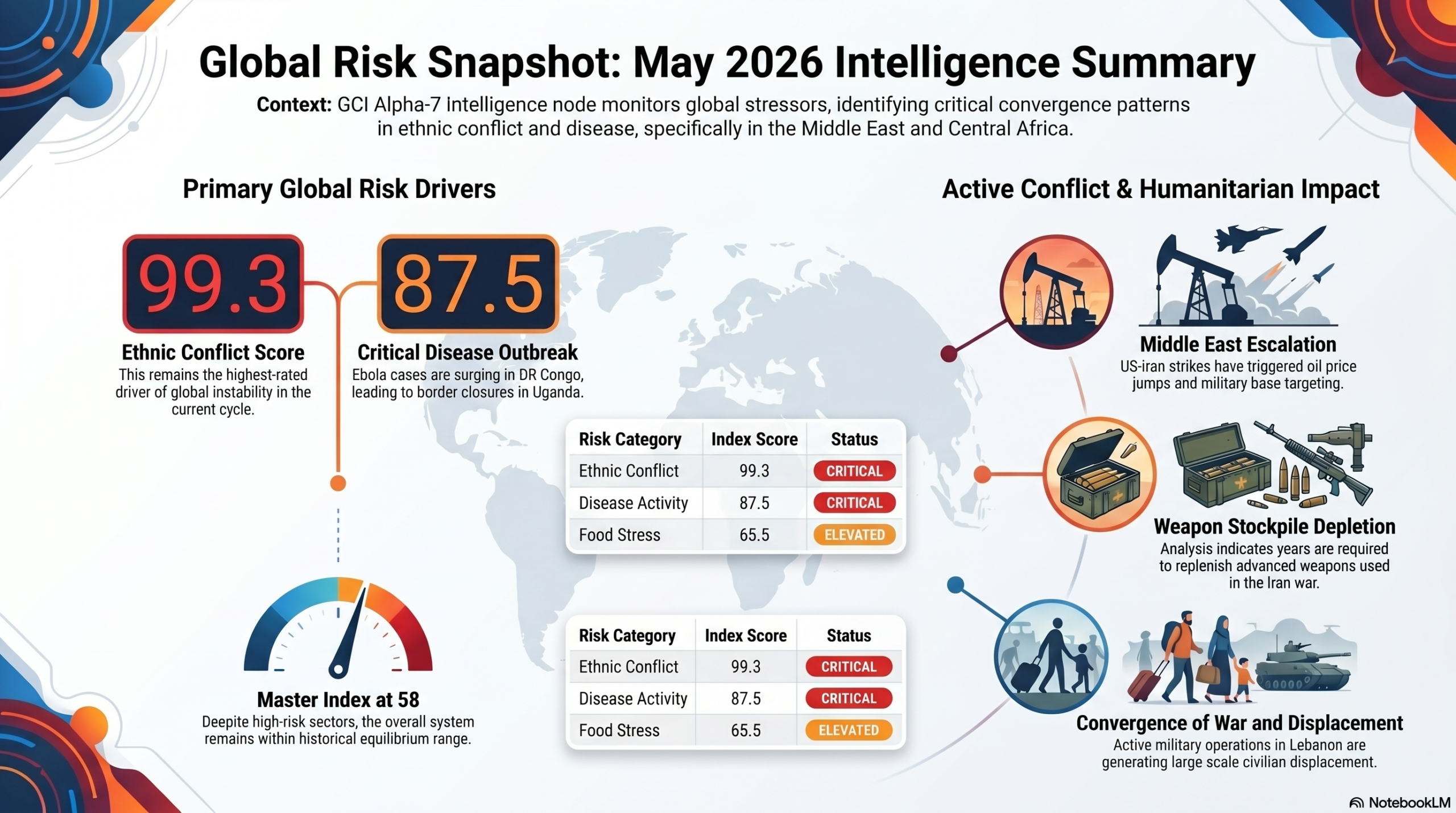
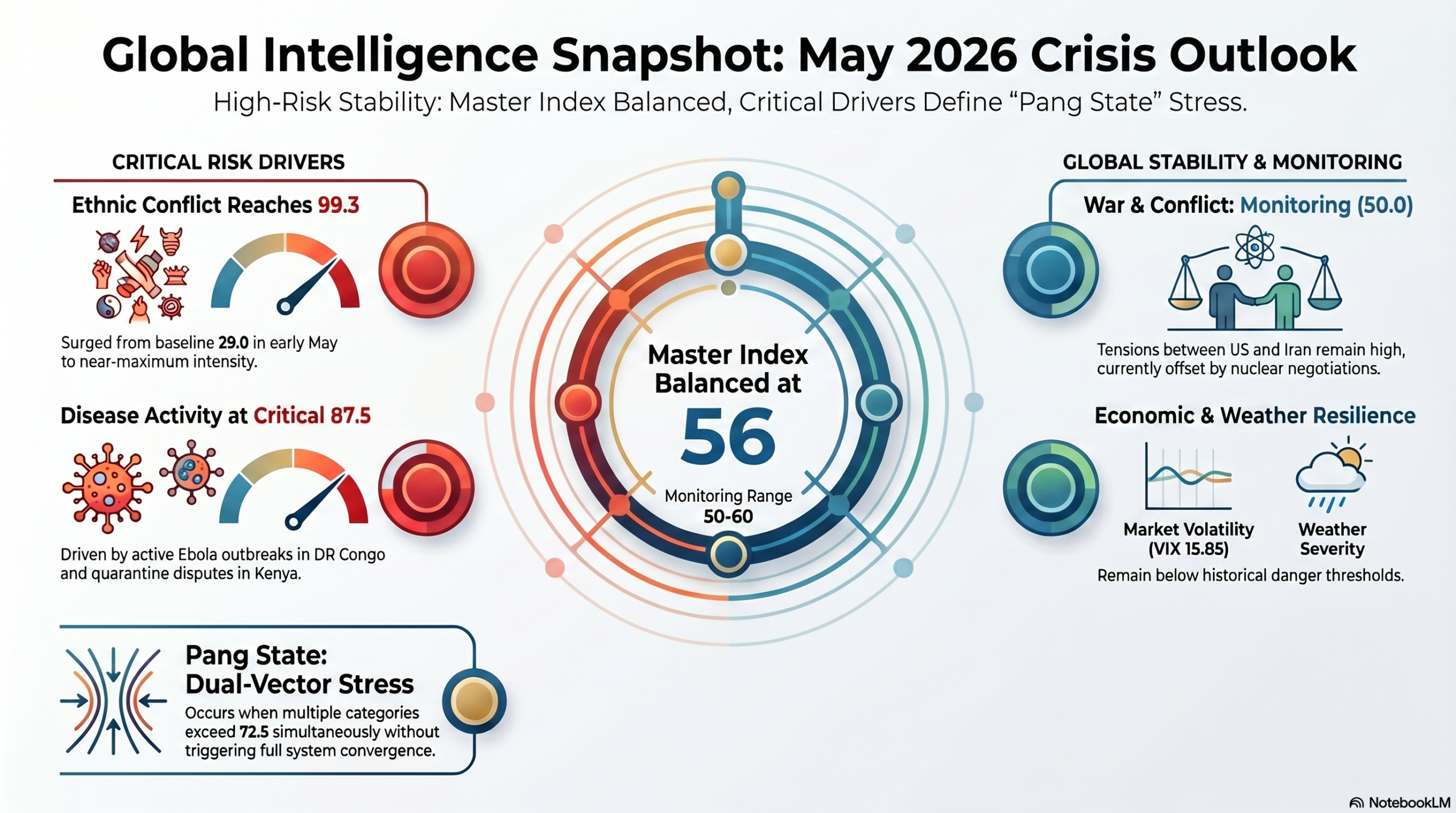
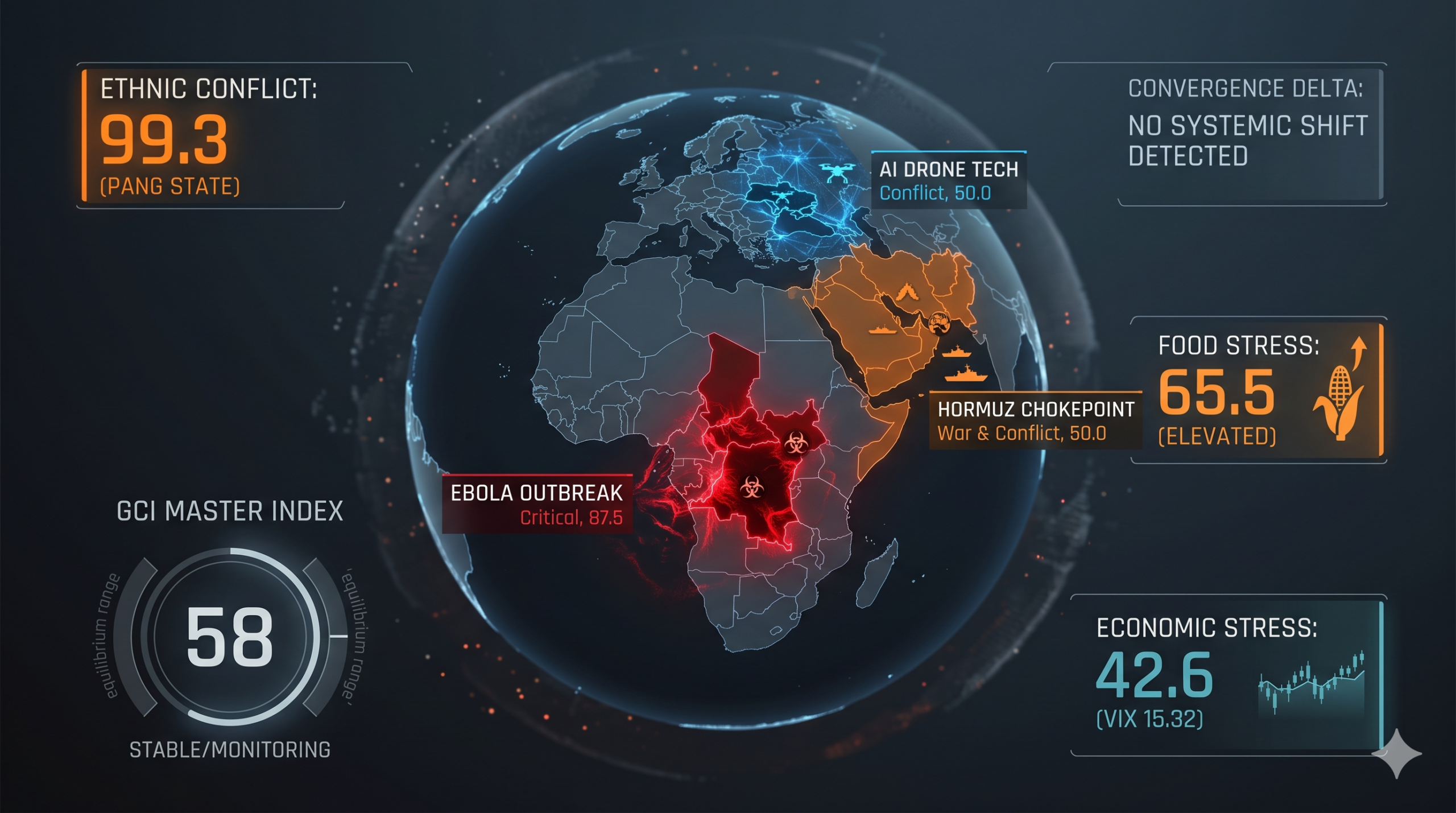
As of May 31, 2026, the Global Crisis Intelligence (GCI) Master Index stands at 58 , indicating that the global system remains within its historical equilibrium range. While the overall system stability is classified as “Monitoring,” specific sectors—most notably Public Health and Food Security—are experiencing significant volatility.The primary drivers of global stress are currently Ethnic Conflict (99.3) and Disease Activity (87.5) , both of which have reached “Pang State” levels (scores ≥72.5). Disease activity is currently categorized as Critical , fueled by an accelerating Ebola outbreak in the Democratic Republic of Congo. Conflict remains a high-priority monitoring area, with Iran reasserting control over the Strait of Hormuz and Ukraine deploying advanced AI drone technology against Russian logistics.Despite these intense localized pressures, the Convergence Delta indicates that these stressors are currently operating in isolated domains. There is no confirmed cross-category amplification, meaning the “birth pang” convergence pattern required for a systemic shift has not yet manifested in this reporting cycle.
GCI Metric Overview
- The status of primary monitoring channels as of May 31, 2026, is summarized below:
- Ethnic Conflict: Score of 99.3 (Pang State), driven by ongoing regional tensions.
- Disease Activity: Score of 87.5 (Critical), influenced by Ebola in the DRC and health infrastructure strain.
- Rumors of War: Score of 70.0 (Monitoring), focused on Iran/Middle East and Ukraine.
- Food Stress: Score of 65.5 (Elevated), with an FAO Price Index of 130.7 compared to a 108.0 baseline.
- War & Conflict: Score of 50.0 (Monitoring), concerning Strait of Hormuz transit and AI drone strikes.
- Civil Unrest: Score of 48.0 (Monitoring), with no significant new activity reported.
- Seismic Activity: Score of 45.6 (Monitoring), with 12 M4.5+ events recorded against a daily baseline of 13.2.
- Economic Stress: Score of 42.6 (Monitoring), with the CBOE VIX at 15.32 versus a 19.5 baseline.
- Weather Severity: Score of 32.3 (Stable), noted by 159 NOAA alerts focused on high winds.
- Humanitarian Impact: Score of 18.9 (Stable), involving drought in Central Africa and Madagascar.
Thematic Analysis of Global Stressors
1. War and Conflict: Tactical Shifts and Strategic Chokepoints
The conflict landscape is dominated by territorial control in the Middle East and technological evolution in Eastern Europe.
- Middle East Escalation: Iran has tightened its grip on the Strait of Hormuz, issuing warnings to vessels and mandating travel through designated routes. The U.S. reported intercepting a merchant ship attempting to breach a blockade to reach Iran. Despite high-level meetings involving the Trump administration, no deal has been reached regarding a “final determination” on the Iran situation.
- Ukraine Technological Warfare: Ukrainian forces are increasingly utilizing AI drones to target vital Russian supply convoys. Concurrently, the World Bank has launched a new project aimed at transforming Ukraine’s social protection system to bolster domestic resilience.
2. Disease Activity: Critical Public Health Emergencies
Public health is the most volatile sector in the current index, characterized by high-fatality outbreaks and legal-logistical hurdles.
- Ebola Crisis in DR Congo: The situation in the Democratic Republic of Congo is “deeply alarming,” with the WHO reporting that the spread of the Bundibugyo Ebola Virus Disease is outpacing the international response. Cases continue to rise at the epicenter, prompting a site visit from the WHO chief.
- Logistical Barriers: A Kenyan court has blocked a U.S. plan to open an Ebola quarantine center intended for treating Americans, highlighting the geopolitical complexities of pandemic management.
- Domestic Issues (U.S.): Public health concerns extend to inhumane conditions at ICE’s Camp East Montana, which has resulted in legal action. Awareness campaigns for Neurofibromatosis are also noted in Missouri.
3. Food and Economic Security
While market fear remains low, the cost of essential commodities is rising significantly.
- Food Price Spikes: The FAO Food Price Index has reached 130.7, a significant increase from the 108.0 baseline (2014-16=100). This indicates sustained food stress and potential supply blockades.
- Market Volatility (VIX): The CBOE VIX sits at 15.32, which is notably lower than the historical baseline of 19.5, suggesting that financial markets have not yet priced in the elevated geopolitical and biological risks present in the report.
4. Environmental and Humanitarian Impact
Environmental stressors are currently categorized as stable but require monitoring for agricultural implications.
- Severe Weather: NOAA has issued 159 active alerts in the U.S., with “Severe” warnings for high winds in the North Snowy Range Foothills and high wind watches in the Central Laramie Range and Southwest Platte County.
- Agricultural Drought: Medium-impact agricultural droughts are affecting 272,473 km² across Angola, the Democratic Republic of Congo, Gabon, and Zambia. A separate drought event in Madagascar covers 223,673 km².
- Seismic Activity: Seismic events are slightly below the historical daily baseline, with 12 M4.5+ events recorded in the last 24 hours.
Convergence Delta and Systemic Outlook
The GCI monitoring system identifies a Convergence Delta when multiple stress categories begin to amplify one another. Current data indicates:
- Isolated Domains: Although Ethnic Conflict and Disease are both in “Pang State,” their activities remain concentrated in specific geographic and functional areas.
- No Cross-Category Amplification: The intelligence confirms that these drivers are not yet merging to create a “birth pang” convergence—a pattern that typically precedes a major global systemic shift.
- Status: The system remains within its historical equilibrium range with a Master Index of 58. However, the critical nature of the Ebola outbreak and the tightening control of the Strait of Hormuz represent the two most likely vectors for future systemic destabilization.
I’m Wayne – and that’s our world today!