
Executive Summary
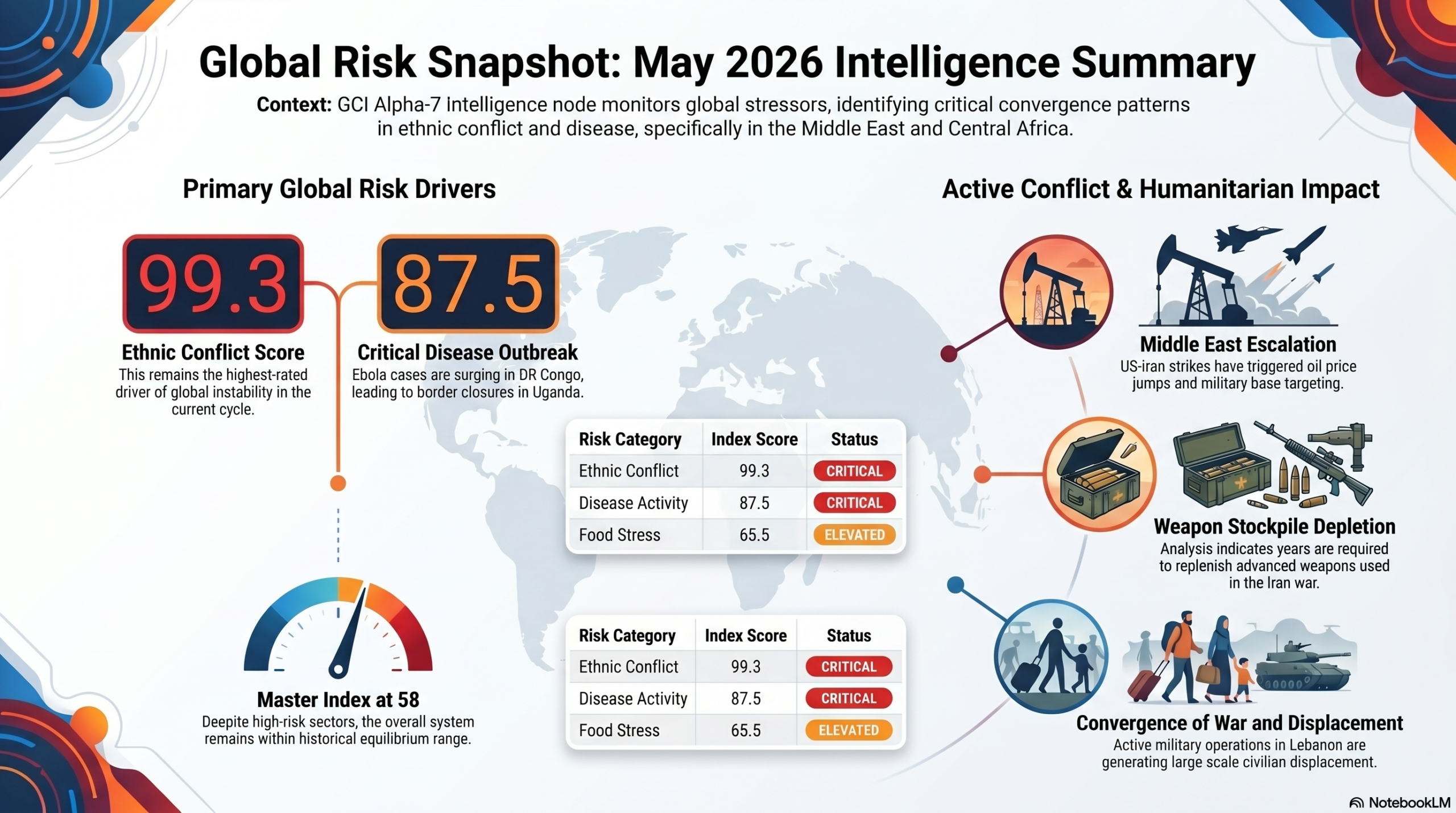
Welcome to today’s Global Intelligence Briefing from GCI Alpha-7. As of May 25, 2026, the Master Index stands at 59, indicating a system within its historical equilibrium range. While the overall system does not currently exhibit a “birth pang” convergence pattern, significant stressors are localized within specific sectors. The primary drivers of global instability are Ethnic Conflict (99.3), Disease (80.0), and Rumors of War (70.0). The most critical immediate threats are the Ebola outbreak in the Democratic Republic of Congo (DRC) and ongoing geopolitical friction in West Asia and Ukraine. While a potential peace deal between the United States and Iran has led to a slight cooling of market fear and a slide in oil prices, the humanitarian and biological sectors remain in “Critical” or “Elevated” states.
Sector Analysis: Primary Drivers and Indicators
1. War and Conflict (Monitoring: 50.0)
The conflict landscape is dominated by high-stakes diplomacy regarding Iran and continued kinetic activity in Ukraine.
- US-Iran Negotiations: Conflicting reports surround a potential deal. While President Trump has publicly stated he will not “rush into” an agreement, Senator Rubio indicated that a “solid” deal could be reached as early as Monday.
- Key Terms: Negotiations reportedly include the reopening of the Strait of Hormuz.
- Market Impact: Oil prices have begun to slide on the anticipation of a peace deal.
- Regional Friction: Iran’s soccer federation has moved its World Cup base camp from the United States to Mexico, and reports of missile strikes in the Strait of Hormuz persist.
- Ukraine-Russia Conflict: A large-scale Russian attack on Ukraine has resulted in four deaths and dozens of injuries, maintaining a high baseline of regional violence.
2. Disease Activity (Critical: 80.0)
The biological sector is the most volatile category in the current cycle, driven by both active outbreaks and historical research into viral pathogens.
- Ebola Outbreak (DRC): The situation in the Democratic Republic of Congo is classified as critical. Efforts to contain the virus are hampered by:
- Aid cuts and reduced funding.
- Armed rebel activity in the region.
- Civilian anger and distrust.
- The deaths of Red Cross volunteers from suspected Ebola infections.
- Hantavirus: Recent intelligence highlights the role of African laboratories in identifying and cracking previous hantavirus outbreaks, emphasizing the importance of regional health infrastructure.
3. Food and Weather Stress (Elevated: 65.5 and 68.8)
There is a noted intersection between atmospheric events and agricultural output.
- FAO Food Price Index: Currently stands at 130.7 , significantly above the baseline of 108.0 (2014-16=100).
- Weather Severity: NOAA has 389 active US alerts, including 50 “Severe” alerts, primarily involving special marine warnings in the Florida panhandle and waterways.
- Agricultural Compression: Atmospheric events are actively compressing agricultural output, contributing to the elevated food stress score.
4. Humanitarian Impact and Seismic Activity
While these categories remain relatively stable, specific regional droughts pose long-term risks.
- Drought Alerts (GDACS Orange):
- Central/Southern Africa: Medium impact agricultural drought affecting 272,473 km² across Angola, DRC, Republic of Congo, Gabon, and Zambia.
- Madagascar: Medium impact agricultural drought affecting 223,673 km².
- Seismic Activity: Relatively stable with 10 events of M4.5+ in the last 24 hours, which is below the historical baseline of 13.2 per day.
Intelligence Convergence Data
The GCI Alpha-7 report identifies specific “Convergence Deltas” where multiple stressors overlap to create heightened systemic risk.| Category A | Category B | Interaction Dynamics || —— | —— | —— || Ethnic Conflict | Disease | Both are in “Pang State” (Score ≥72.5), indicating dual-vector stress. || Weather Severity | Food Stress | Atmospheric events are directly impacting and compressing global food supply. || Disease Activity | Civil Unrest | Health infrastructure stress is co-occurring with social instability, notably in Turkey and the DRC. |
Key Data Points
- CBOE VIX: 16.64 (Below historical baseline of 19.5), indicating that despite geopolitical rumors of war, market fear remains relatively low.
- Civil Unrest: Notable escalation in Turkey, where riot police stormed opposition offices following the ousting of political leaders.
- Displacement: Ongoing humanitarian crises in South Sudan and Malawi continue to drive regional displacement figures, as noted by the WFP and ReliefWeb.
Concluding Summary
The global system is currently defined by a “Moderate Convergence.” While the Master Index is not signaling an imminent global shift (at 59/100), the extreme score in Ethnic Conflict (99.3) combined with Critical Disease Activity (80.0) creates a volatile environment. The potential for a US-Iran peace deal remains the primary variable that could either de-escalate the “Rumors of War” driver or, if negotiations fail, trigger a sharp increase in Economic and War indicators.