The July 2026 Risk Report: 5 Surprising Takeaways from the Global Intelligence Frontlines
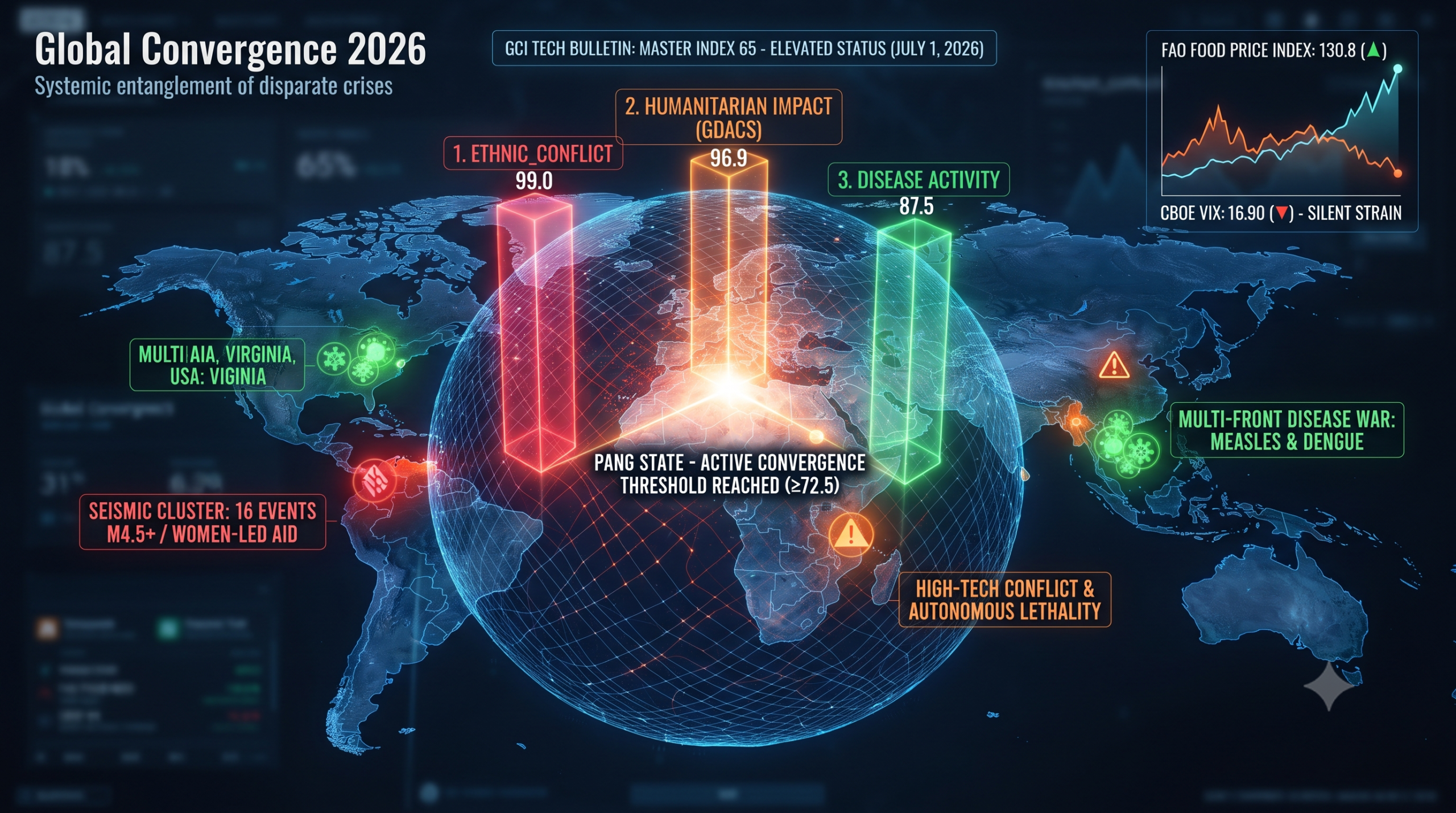
Global Convergence 2026 is the defining reality as we cross the threshold into the second half of the year on July 1. This landscape is increasingly defined by the messy, often violent intersection of once-disparate crises. This is no longer a world where we can analyze a pandemic in a vacuum or treat a seismic event as a mere geological anomaly; instead, we are entering a period of systemic entanglement.
The latest GCI Tech Bulletin from Node: Alpha-7 provides a sobering data-driven window into this new reality. While the Master Index sits at 65—an “Elevated” status—the underlying data reveals a world vibrating with geospatial fragility. Here are five essential takeaways from the intelligence frontlines.
1. The “Pang State” Phenomenon: When Risks Collide
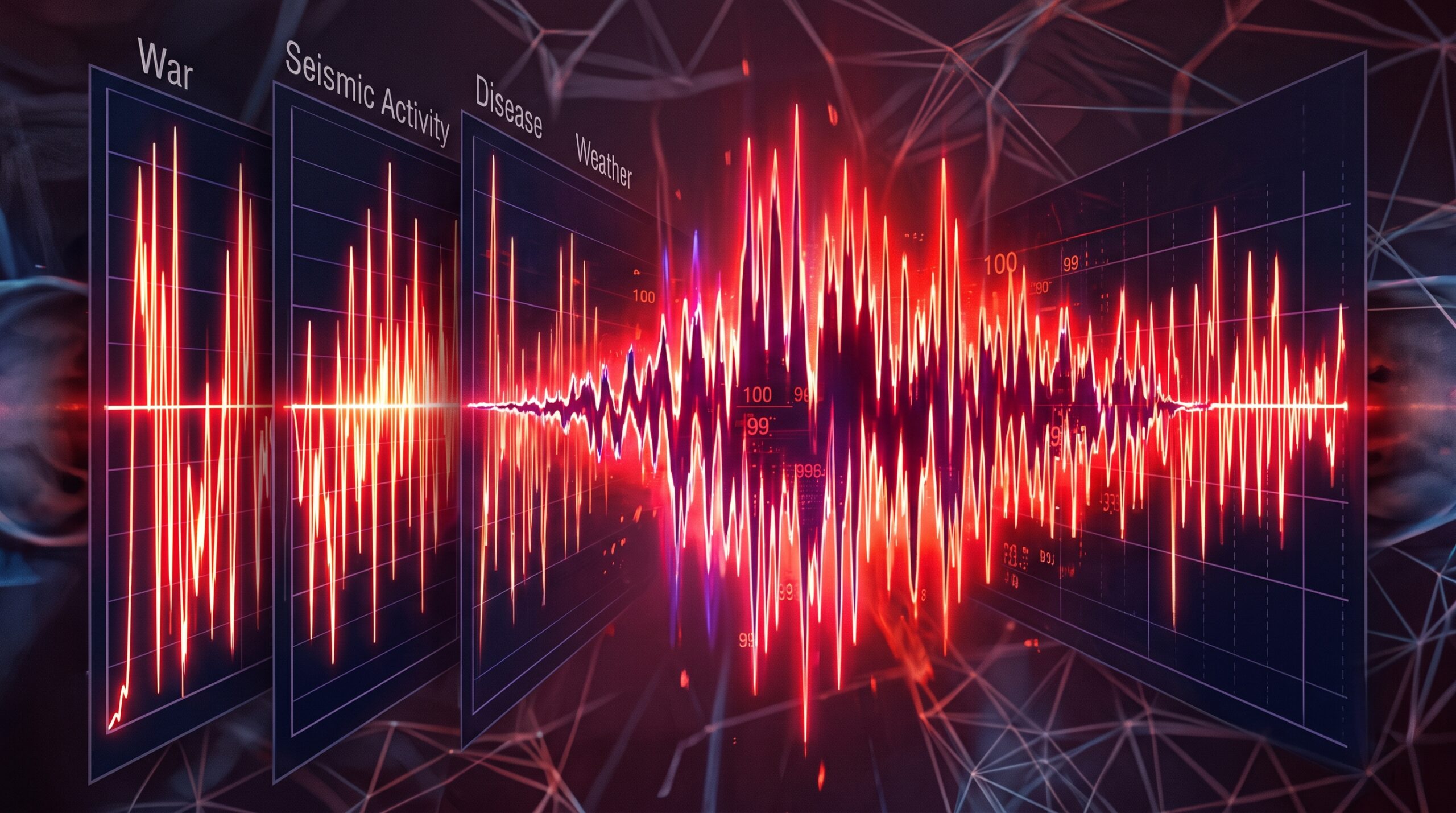
The most significant architectural shift in the July 1 report is the emergence of a “Pang State” across three critical risk pillars. In the nomenclature of risk intelligence, a Pang State is triggered when a channel reaches a threshold of 72.5 or higher. Currently, Ethnic Conflict (99.0), Humanitarian Impact (GDACS at 96.9), and Disease Activity (87.5) have all cleared this bar.
However, there is a vital distinction for the strategic planner: while these individual “forest fires” are at Pang State levels, the global forest—the Master Index—remains at 65. The system has not yet reached the three-channel simultaneous convergence required for a total global state change. We are witnessing a world of localized infernos that the global center is still, tenuously, managing to ignore.
“3 channels simultaneously in Pang State (≥72.5): ETHNIC_CONFLICT, GDACS, DISEASE — Active Convergence threshold reached.”
This threshold indicates that while the global system hasn’t tipped into a total “Phase 4” collapse, the primary drivers of our current instability are no longer economic or political—they are visceral and existential.
2. Venezuela’s Seismic Fragility and the Rise of Women-Led Aid
Venezuela is currently the epicenter of a catastrophic seismic cluster that is rewriting the rules of disaster logistics. In the last 24 hours, the USGS recorded 16 events of M4.5 or greater, significantly overshooting the historical baseline of 13.2. As aftershocks continue to fray nerves and preliminary debris quantification begins, the response highlights a shift toward localized infrastructure resilience.
Humanitarian efforts are being spearheaded by women-led organizations in partnership with CARE. This isn’t just a grassroots success story; it is a necessity driven by the breakdown of traditional state capacity. This localized leadership is being synchronized by the “Global LTC Telecoms Teleconference,” a critical node for maintaining the communications backbone required for rescue efforts. In a region where the ground is literally shifting, the ability to maintain a digital signal is as vital as the delivery of clean water.
3. The Multi-Front Disease War: Pathogen Volatility
The Disease Activity channel has reached a “Critical” score of 87.5, reflecting a startling geographical breadth of threats that ignore the traditional borders of wealth and development. We are seeing a multi-front war where high-income zones and developing regions are under simultaneous stress.
- North America: A measles outbreak in Virginia has expanded into Cumberland County, exposing the fragility of routine immunization in even the most “secure” regions.
- South Asia: The National Dengue Control Unit in Sri Lanka reported a critical status as of midnight June 30, a sharp reminder of how climate-driven disease cycles are accelerating.
- Europe & Africa: An Ebola alert at a Glasgow hospital (which tested negative) coincided with active WFP responses to actual Ebola outbreaks in the Democratic Republic of Congo.
“DISEASE ACTIVITY (87.5) CRITICAL… Primary Drivers [of Global Risk Index]: ETHNIC_CONFLICT (99.0), GDACS (96.9), DISEASE (87.5)”
The data confirms that the global risk profile is being shaped by a lethal feedback loop: ethnic conflict (99.0) displaces populations, which spikes humanitarian impact (96.9), which in turn fuels pathogen volatility.
4. The Silent Strain of Food Inflation
There is a jarring disconnect between the boardrooms of Wall Street and the kitchen tables of the global majority. While the CBOE VIX—the market’s “fear index”—sits at a tranquil 16.90 (well below the 19.5 baseline), the FAO Food Price Index has surged to 130.8 against a 108.0 baseline.
This represents the “Silent Strain” of 2026. While energy markets are seeing a “welcome breather” with falling fuel prices, food costs remain stubbornly high and supply chains remain brittle. This suggests a decoupling of market volatility from human survival. Hunger remains the primary driver of civil unrest, even when financial indicators suggest a period of relative calm. Stable markets do not equal stable societies when the cost of bread remains at record highs.
5. High-Tech Conflict and the Paradox of Monitoring
The War & Conflict channel is currently categorized as “Monitoring” with a score of 50.0. From a futurist’s perspective, this score feels dangerously conservative. We are seeing a normalization of autonomous lethality; in Myanmar’s Noh T’Kaw Township, a drone strike recently killed villagers and destroyed property, marking another chapter in the “peripheral” drone wars that rarely make the evening news.
Simultaneously, reports from Sudan detail a “City Under Siege” in North Darfur, with documented crimes against humanity. There is a profound “asymmetric reality” at play here. While these high-tech atrocities unfold, the bulletin notes that in the United States, groups like the Nacogdoches Federation of Women’s Clubs are preparing “patriotic living-history shows.” This juxtaposition is the defining characteristic of 2026: a world where segments of the population live in a curated past, while others are targeted by the autonomous warfare of the future.
Conclusion: A Question for the Near Future
As of July 1, 2026, the GCI Master Index stands at 65. We are “Elevated,” yet we have not hit the total global convergence that would signal a systemic collapse. Our current stability is a fragile equilibrium maintained by the skin of our teeth.
The data leaves us with a provocative question: Are our global response systems—from the women-led aid networks in Caracas to the vaccine momentum at SK Bioscience—evolving at the same exponential rate as the “Pang State” risks they are fighting? If our logistical and health infrastructures cannot keep pace with the convergence of conflict, disease, and seismic shifts, the Master Index’s move from 65 to 72.5 may happen faster than we are prepared to handle.