Executive Summary
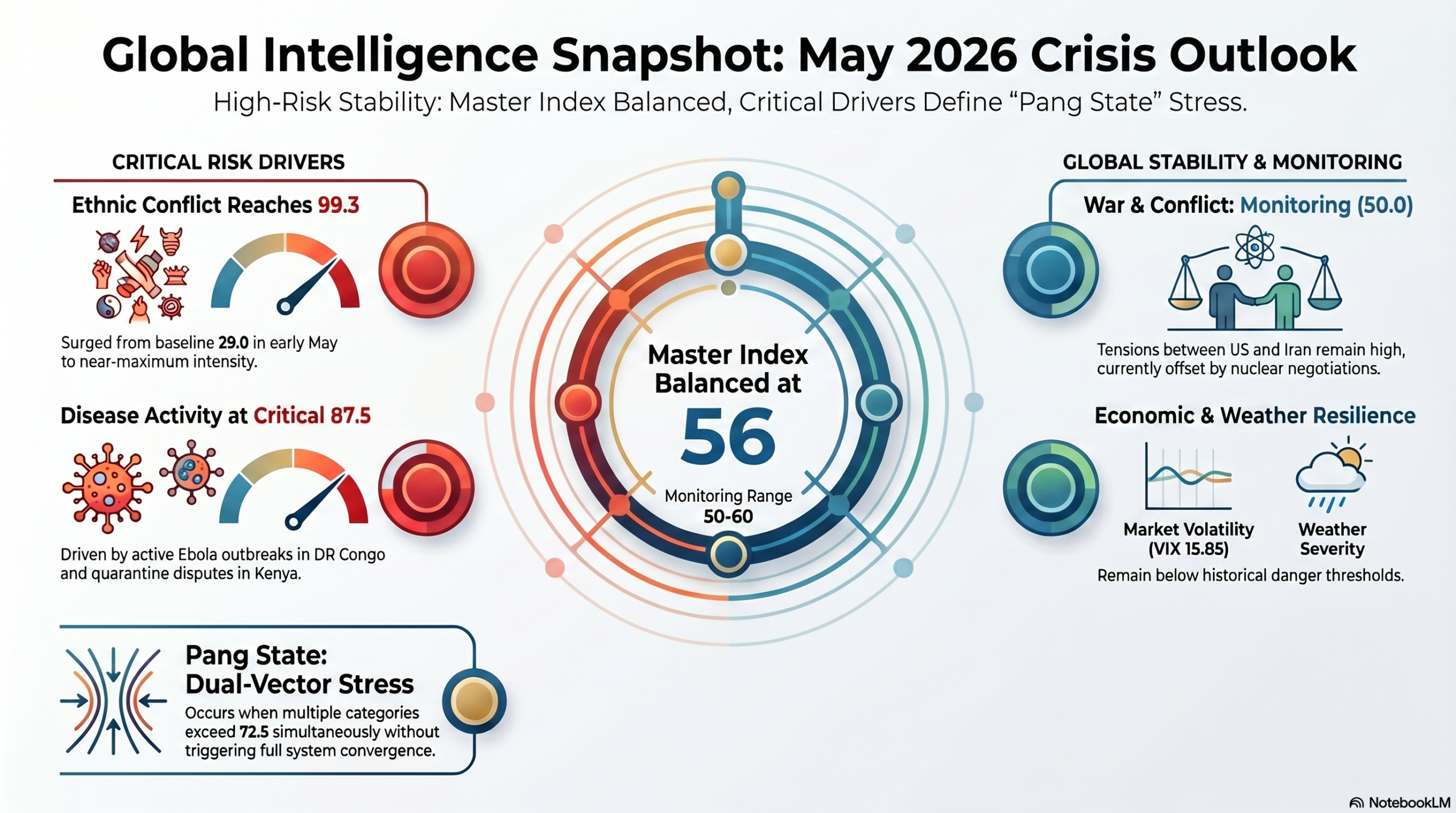
As of May 29, 2026, the GCI Alpha-7 Global Intelligence Master Index stands at 56 , indicating a state within the historical equilibrium range. While the overall system is not currently exhibiting a “birth pang convergence pattern,” significant volatility is localized within specific risk vectors.The primary drivers of global instability are Ethnic Conflict (99.3) , Disease Activity (87.5) , and Rumors of War (70.0) . The most critical escalation is observed in Ethnic Conflict, which has surged from a score of 29 in late April to near-maximum saturation. Disease activity remains at a “Critical” level, primarily driven by a resurgence of Ebola in Central Africa and associated diplomatic hurdles in Kenya. In the geopolitical arena, tensions between the US and Iran remain fluid, with conflicting reports of military intercepts and progress toward nuclear negotiations.
Core Risk Metrics and Trend Analysis
Longitudinal Data Observations (April 29 – May 29)
Data from the past 30 days reveals a significant shift in global risk architecture:
- Ethnic Conflict Spike: This metric was the most volatile, rising from 29.0 on April 29 to a sustained 99.0 by late May.
- Disease Consistency: Health risks have remained high, fluctuating narrowly between 80.0 and 88.0 throughout the month.
- Master Index Stability: Despite spikes in individual categories, the Master Index peaked at 67.0 in late April and has since cooled to its current 56.0.
Detailed Thematic Analysis
1. War and Geopolitical Conflict
Military activity and diplomatic maneuvering are concentrated in the Middle East and Eastern Europe.
- US-Iran Relations:
- Iran’s air defenses reportedly intercepted US aircraft over Bushehr Province.
- Contradictory diplomatic signals exist; US officials claim Trump’s pressure has brought Iran to the table for nuclear talks, and Vice President Vance noted the parties are “very close” to a deal, though Trump’s final backing remains uncertain.
- Israel and Levant Operations:
- Prime Minister Netanyahu has directed the IDF to increase control of Gaza to 70%.
- Reports indicate Israel has intensified strikes on Lebanon despite a ceasefire.
- Hezbollah has reportedly adopted fiber-optic drone technology, a tactic learned from the war in Ukraine, to strike Israeli targets.
- Ukraine-Russia Conflict:
- Ukraine’s foreign minister suggests that increasing drone attacks within Russian territory could pressure the Kremlin to end the war.
- Economic pressure continues with the US imposing significant oil sanctions on Russia.
2. Disease Activity and Health Emergencies
The disease vector is currently classified as Critical (87.5) , with focus on viral outbreaks and the “disinformation virus.”
- Ebola Resurgence:
- Multiple reports confirm a new Ebola Virus Disease (BVD) outbreak in the Democratic Republic of Congo (Bundibugyo), marking the 17th such epidemic in the RDC.
- The US has allocated an additional Ksh. 10.3 billion to combat the spread.
- In Kenya, a court has halted the opening of a US-funded Ebola quarantine facility, complicating regional response efforts.
- Information Integrity: Analysts are framing disinformation as a “virus” that undermines both public health and democratic institutions, requiring specific “treatment” protocols.
3. Food and Economic Stress
While the VIX (CBOE Volatility Index) remains low at 15.85 (below the historical baseline of 19.5), food security is a growing concern.
- FAO Price Spikes: The FAO Food Price Index has reached 130.7 , significantly higher than the baseline of 108.0 (2014-16=100).
- Supply Risks: Elevated food stress is being driven by supply blockades and price volatility.
4. Humanitarian and Environmental Factors
Environmental stressors are currently stable but show medium-impact agricultural risks in specific regions.
- Agricultural Drought: GDACS has issued Orange alerts for medium-impact agricultural droughts in:
- Southern/Central Africa: Angola, Democratic Republic of Congo, Republic of Congo, Gabon, and Zambia (impacting 272,473 km²).
- Madagascar: Impacting 223,673 km².
- Weather Alerts (US): NOAA reports 187 active alerts, including “Severe” Red Flag Warnings in the Northwest Plateau and West Central Mountains, and Flood Warnings in South Carolina (Calhoun and Richland counties).
- Seismic Activity: Within the last 24 hours, 8 events of M4.5+ occurred, which is below the historical baseline of 13.2 per day.
Convergence Delta
The “Convergence Delta” monitors how different risk categories intersect to amplify global stress.
- Dual-Vector Stress: Both Ethnic Conflict and Disease are in “Pang State” (scores ≥72.5). While they are currently operating in isolated domains without confirmed cross-category amplification, they represent a significant dual-vector threat.
- War-Humanitarian Linkage: A confirmed intersection exists between War & Conflict and Humanitarian Impact, as active military operations in Sudan and the Middle East are directly generating civilian displacement and necessitating WFP intervention.
- System Equilibrium: The Master Index of 56 suggests the global system remains within a historical equilibrium range for this cycle, despite the extreme saturation of the Ethnic Conflict metric.
I’m Wayne and that’s our world today!