1. The Hour of Eighteen Quakes
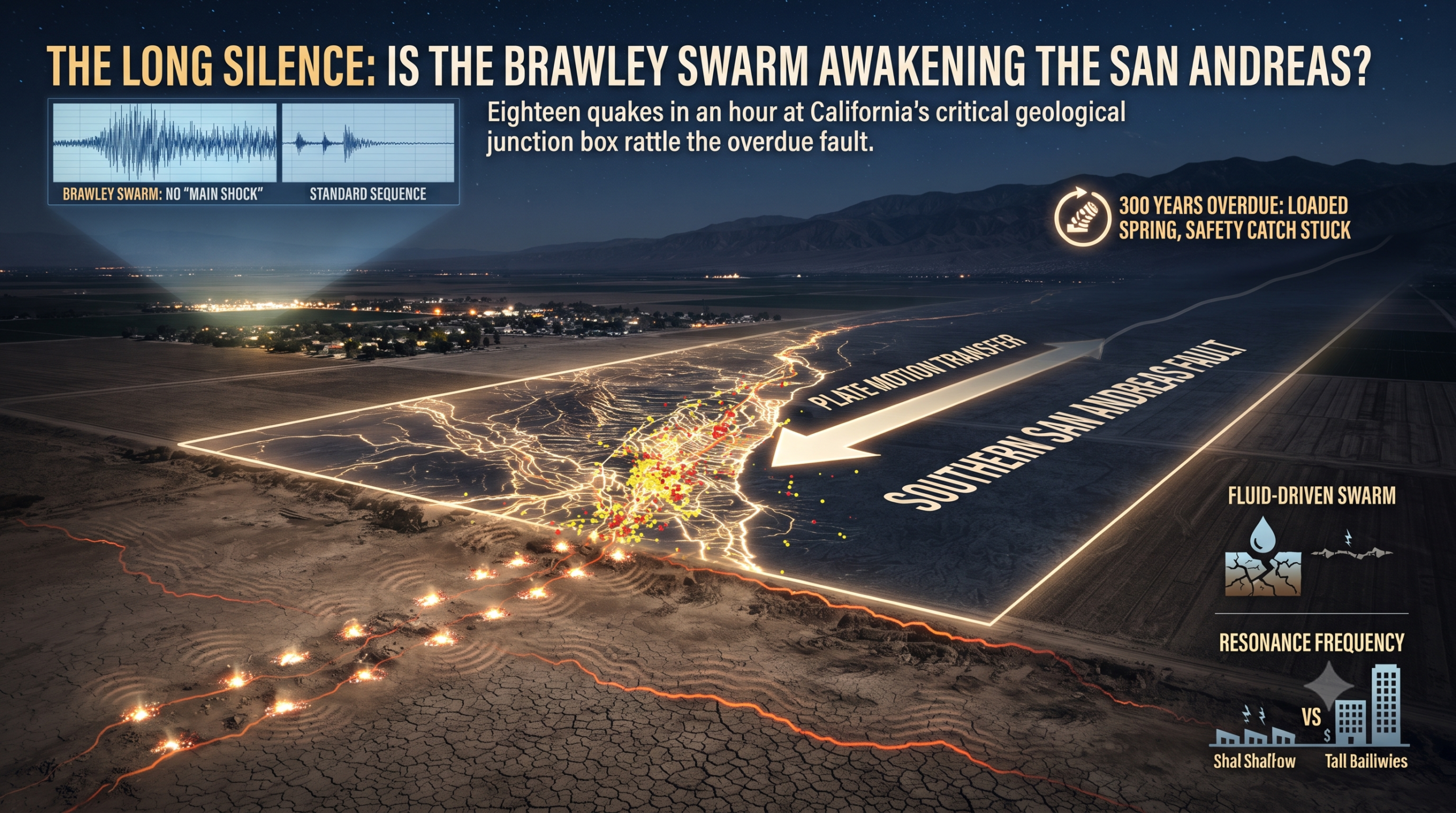
have rattled the southern doorstep of California’s most infamous fault line. Because this specific section is 300 years overdue for a major rupture, scientists are watching these localized San Andreas earthquake swarms closely to determine if physical stress is actively transferring to the quietest, most dangerous parts of the fault.
Just after midnight beneath the Imperial Valley, the Brawley Seismic Zone reactivated with a characteristic stuttering rhythm. In a single hour, beginning at 12:14 a.m., the ground beneath this California farming community cracked eighteen times. It began with a magnitude 3.1, followed by a 3.6—the strongest of the night—and a 3.4. By sunrise, dozens of smaller events were layered on top of the sequence.While Southern California is no stranger to seismic activity, this event presents a specific mystery: there was no “main shock.” This lack of a clear leader is the primary indicator of an earthquake “swarm.” More importantly, this activity is unfolding at the southern doorstep of the San Andreas fault—a stretch of the state’s most famous plate boundary that has remained ominously silent for over 300 years.
2. The “No-Leader” Sequence: Why Swarms Break the Rules
In a standard earthquake sequence, a single large jolt releases the bulk of the built-up stress, followed by a predictable trail of shrinking aftershocks as the crust settles. A swarm ignores this script entirely. It consists of a cluster of events of similar size arriving in an irregular rhythm.This “no-leader” behavior is unsettling for seismologists because it removes the ability to look in the “rearview mirror” to determine if the danger has passed. In a normal sequence, the worst is statistically behind you once the main shock occurs. In a swarm, the largest event could be the first, the middle, or one that hasn’t happened yet. This patch of ground has a history of such behavior, notably in 2012 (which produced magnitude 5.3 and 5.5 events), 2016, 2020, and most recently in May 2026, when a magnitude 4.7 swarm woke residents as far away as San Diego.Brawley is not a random location; it functions as a “geological junction box,” the specific point where the Imperial fault hands off plate motion to the southern terminus of the San Andreas.”That missing main shock is the entire story. It is the fingerprint of something seismologists call a swarm.”
3. It’s a Fluid Problem, Not Just a Stress Problem
The technical distinction between a standard fault rupture and a swarm often comes down to the underlying driver. While most earthquakes are “stress problems”—crust building strain until a fault snaps—swarms are frequently “fluid problems.”In the Brawley zone, water and hydrothermal fluids migrate through cracks in the rock, changing the pore pressure acting on a network of small faults. This allows the crust to slip incrementally. Because fluid moves through fractured systems in non-linear ways, swarms do not decay neatly like aftershocks. They can stall out completely and then restart without warning as fluid pressure shifts. This makes standard statistical prediction models nearly impossible to apply.
4. The 300-Year Silence: California’s “Loaded Spring”
The proximity of the “noisy” Brawley zone to the “quiet” Southern San Andreas is the central concern for the state. According to the landmark 2011 trenching study which dated disturbed soil layers, this section of the San Andreas ruptures on average every 180 years.Having not produced a major earthquake since approximately 1690, the fault is not just “overdue”—it is 120 years past its historical average. Seismologists describe this section as a “loaded spring with its safety catch stuck.” While the Brawley swarms are small, the concern is that their constant vibrations might eventually provide the nudge necessary to release over three centuries of accumulated strain—estimated to be several meters of potential slip.
5. The Ghost of Lake Cahuilla: A Natural Trigger Lost
New research published in 2023 offers a compelling theory for this 300-year silence. For millennia, the region was periodically filled by Lake Cahuilla, a massive body of water far larger than the modern Salton Sea.Data suggests that previous major ruptures on the Southern San Andreas lined up closely with periods when the lake was full. The sheer weight of the water acted as a natural trigger, helping the fault release its built-up strain on a regular 180-year schedule. Since the lake disappeared centuries ago, the fault’s “internal clock” has slowed significantly. However, the strain has continued to build regardless of the missing trigger. The “safety catch” is on, but the spring is more heavily loaded than at any point in recorded history.
6. Resonance: Why Shaking Speed Trumps Raw Power
While magnitude (the raw energy) gets the headlines, “resonance frequency” often dictates the damage. This is best illustrated by the “three balls” experiment: when a platform is shaken slowly, only the tallest structures sway; when shaken at high frequency, even if the platform moves only a few millimeters, the shortest structures shake violently.This resonance explains why moderate swarms in the M3.0 to M5.0 range generate such high “felt report” numbers. Because these Brawley quakes are shallow and produce high-frequency vibrations, they can be more unsettling to local infrastructure than a much larger, distant earthquake. Even without a “Big One,” the stuttering rhythm of a swarm can be physically and structurally exhausting for a community.
7. Fact-Checking the Global “Coincidence”
Following the recent activity, online speculation attempted to link the Brawley swarm to a rare magnitude 5.0 earthquake in Spearman, Texas, occurring the same night. Scientifically, this connection is a physical impossibility.The two events were separated by 1,700 kilometers. For a magnitude 3.0 or 4.0 event, meaningful stress transfer only occurs within a few kilometers. Furthermore, global seismic data confirms that the planet produces roughly 150 earthquakes of magnitude 4.5 or greater every week. Two unusual events occurring on the same night is not a hidden continental link; it is simply what ordinary randomness looks like at a global scale.
8. The Watchlist: Three Signals to Track
Seismologists are currently monitoring three specific signals to determine if this swarm is background noise or a precursor:
- Magnitude: Scientists are watching for a push past the 5.5 “historical ceiling” for this zone. If events begin climbing in size rather than fading, the risk profile shifts dramatically.
- Direction: Migration is the most critical factor. This swarm is currently 60 km south of the San Andreas terminus. If activity migrates north toward Bombay Beach—as it did in 2016—the “red alert” begins.
- Official Action: Watch for formal USGS aftershock forecasts. In 2016, when a swarm hit Bombay Beach directly, the USGS raised the odds of a major San Andreas rupture to 1 in 100 (from a background of 1 in 6,000). That remains the benchmark for a serious threat.
9. Conclusion: The Long Silence
The Brawley swarm is likely another episode of background chatter in a region that has seen similar sequences in 2012, 2016, 2020, and just this past May. However, the proximity to the San Andreas remains a legitimate, unresolved mystery.There is a profound irony in the fact that the noisiest patch of crust in Southern California sits directly at the foot of the quietest major fault in the state. While the odds of any single swarm ending the 300-year silence remain low, the proximity is unsettling. We are left watching the noisy doorstep, waiting to see if the vibrations will finally release the catch on California’s most dangerous loaded spring.