The Quiet Storm:
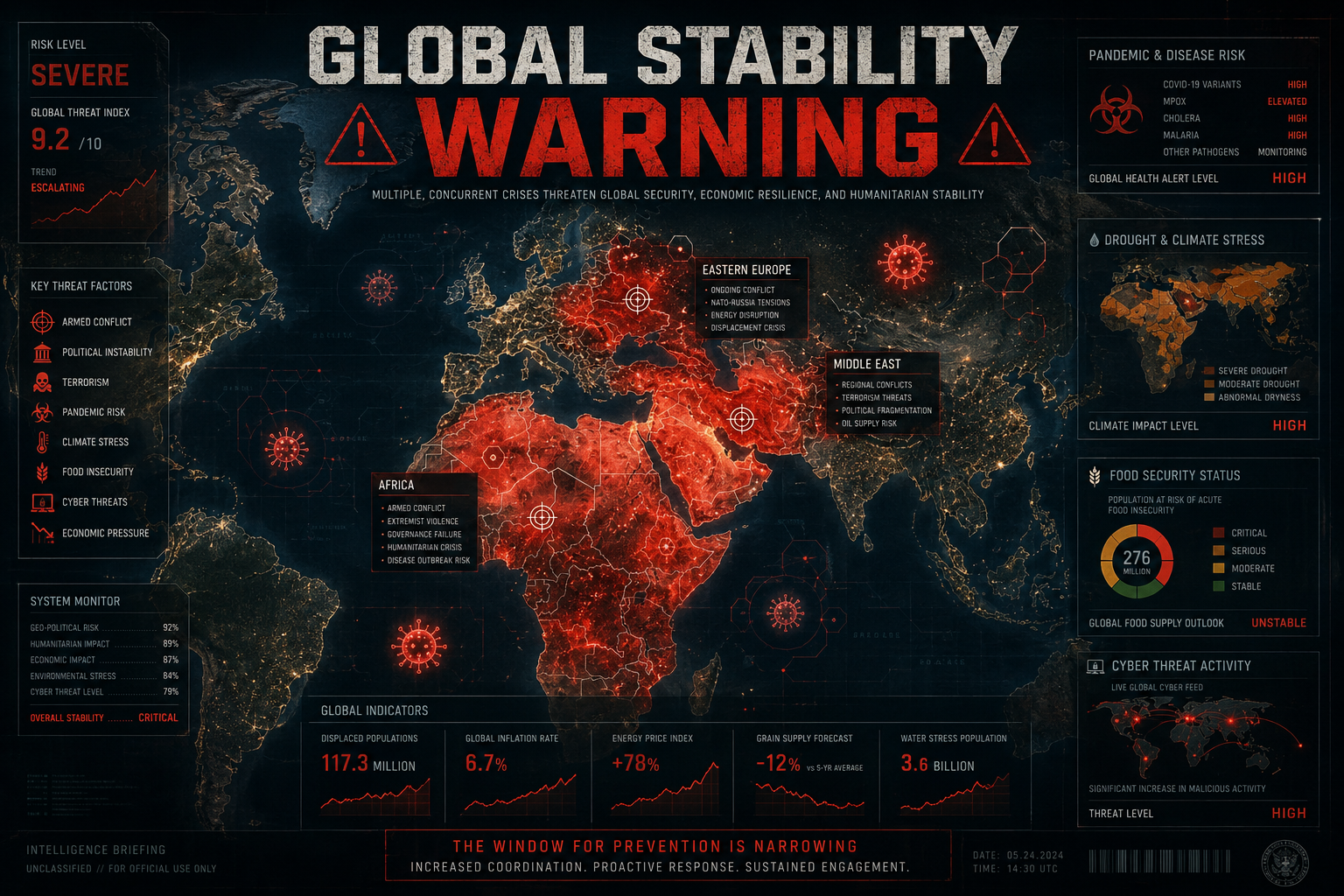
Global stability warning indicators are flashing across multiple sectors as the latest GCI Watchman Report reveals escalating disease outbreaks, rising geopolitical tension, food insecurity, and widening conflict corridors. While the official Master Index still suggests equilibrium, the underlying data paints a far more dangerous picture.
The global system is red-lining, even if the dashboard suggests a smooth ride. At first glance, the GCI Watchman Report: Node Alpha-7 , released May 15, 2026, presents a “Master Index” of 56—a figure that traditionally signals historical equilibrium. But as any seasoned analyst knows, the aggregate is often a lie.This 56 is a mathematical illusion, a mask created because Seismic Activity plummeted (Δ ▼ -22.0), effectively “canceling out” the fact that human-centric drivers are screaming toward a breaking point. While the ground beneath our feet may be still, the geopolitical and biological fault lines are vibrating at a frequency that suggests a “Quiet Storm” is about to break. With “Rumors of War” sitting at 70.0—perilously close to the 72.5 “Pang State” threshold—the margin for error has evaporated.
1. The Invisible Threat: Disease Activity Hits “Critical” Levels
The most immediate threat isn’t a missile; it’s a microbe. The Disease Activity score has surged to a Critical level of 87.5 . This isn’t a localized spike; it’s a multi-theater biological siege. We are seeing a lethal diversity of vectors—hemorrhagic, respiratory, and bacterial—erupting simultaneously across the globe.In the Democratic Republic of Congo, the situation has moved beyond containment:”New outbreak of Ebola kills 65 in eastern DR Congo.”The crisis isn’t confined to the global south. In Europe, the WHO is briefing media in Madrid on a Hantavirus outbreak, while the UK is grappling with a meningitis cluster at a college where one student has died and two others are currently being treated. When pathogens as diverse as Ebola and Hantavirus hit the wire in the same 24-hour cycle, it taxes international response resources to the point of exhaustion. This is no longer a “monitoring” situation; it is a full-scale health emergency.
2. The “Epic Fury” Aftermath and the Iran Debacle
The strategic map of the Middle East is currently being rewritten by what intelligence circles are calling the “Epic Fury” failure . This isn’t a slow-burn decline; it is a real-time collapse of Western leverage. On May 14, 2026, reports confirmed that a “floating armoury” ship was seized by Iran, punctuating a catastrophic 48-hour window for American interests in the region.Washington is currently fighting a multi-theater fire with a dry well. The regional fallout is stark:
- Failed Ceasefires: The ceasefire between Israel and Hezbollah has collapsed, with fighting in southern Lebanon continuing unabated despite ongoing negotiations reported by PBS.
- Strategic Vacuum: The “Epic Fury” debacle has left a vacuum that Iran is aggressively filling, turning a “monitoring” conflict (currently at 50.0) into a volatile staging ground for broader escalation.
- Kinetic Spillover: Simultaneously, Ukraine continues to bleed, with massive Russian strikes hitting civilian infrastructure in Kyiv, proving that the “War & Conflict” index is only stable because the global system is currently numb to the carnage.
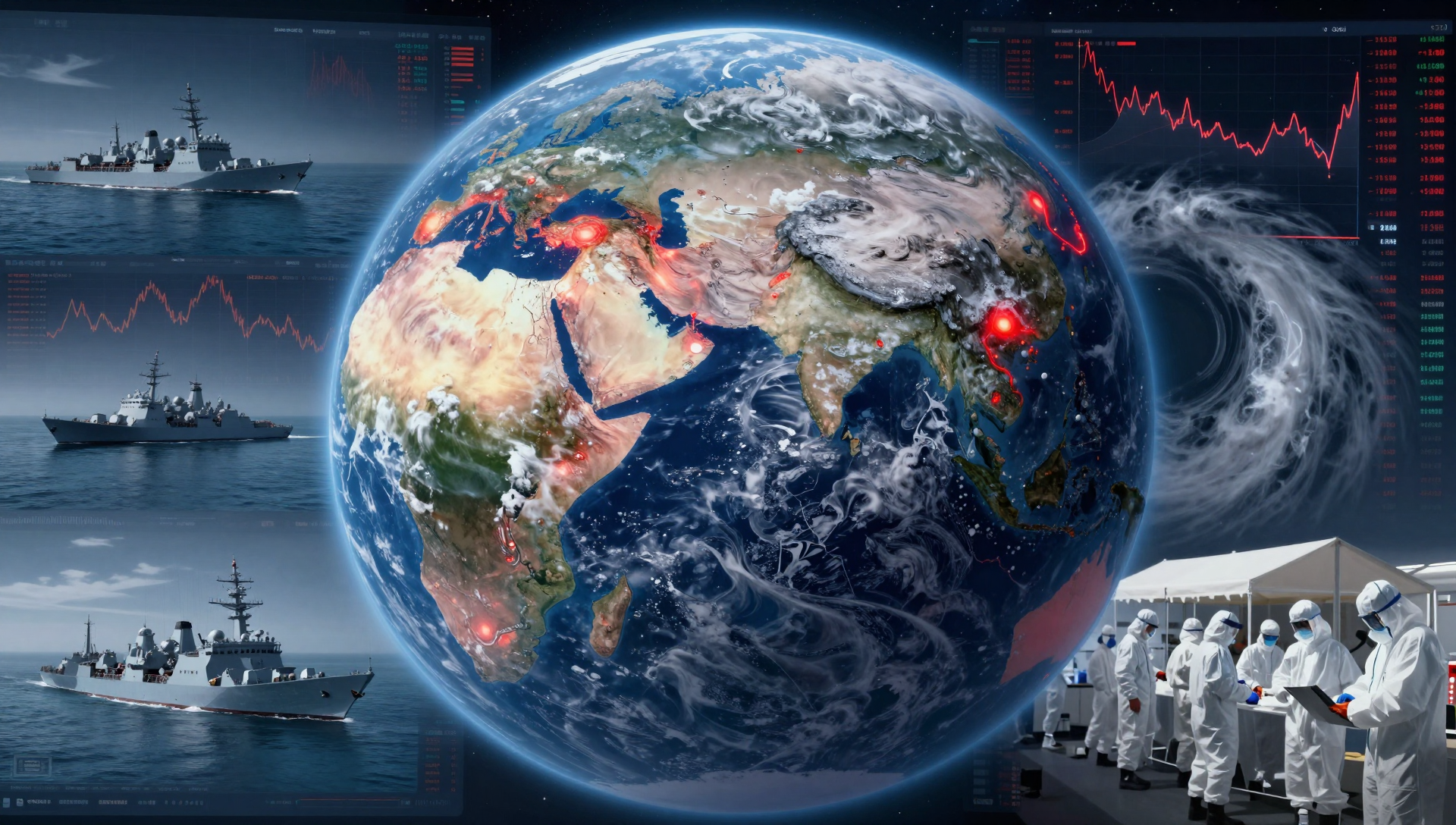
This global stability warning is not driven by a single crisis, but by multiple systems beginning to fail simultaneously.
3. The 130.7 Threshold: Why Food Stress is the New Global Fault Line
We are witnessing the emergence of “multi-vector stress,” where economic volatility meets environmental collapse. The FAO Food Price Index has hit 130.7 , towering over the 108.0 baseline. This economic spike is hitting exactly as the climate fails.The report identifies “Orange” level drought alerts covering a staggering 650,000 square kilometers across two major African zones. This isn’t just a “bad season”; it is a geographic wipeout:
- Zone 1: Angola, Democratic Republic of Congo, Republic of Congo, Gabon, and Zambia are currently under a medium-impact agricultural drought alert.
- Zone 2: Madagascar faces similar devastation.The result is a humanitarian catastrophe that is beginning to spiral in East Africa:”UN agencies warn of worsening hunger and malnutrition crisis in Somalia as famine risk emerges.”When the high cost of imports (130.7 on the FAO index) intersects with the total failure of local harvests, the result isn’t just hunger—it’s a catalyst for mass displacement and the inevitable collapse of civil order.
4. The Convergence Delta: When War and Hunger Intersect
The most chilling revelation in the Alpha-7 report is the “Convergence Delta.” For the first time this cycle, Ethnic Conflict (94.3) and Disease (87.5) are simultaneously in “Pang State”—the report’s technical term for a driver that has exceeded the 72.5 threshold of manageable instability.This is the “Quiet Storm” in data form. While the report currently lists this as “dual-vector stress” rather than “Active Convergence,” the evidence of a system-wide failure is undeniable: 5 out of 8 monitoring categories have verified, high-impact headlines this cycle.We are seeing the early stages of a “birth pang” pattern. In active conflict corridors like Ukraine and the Middle East, war and food stress are no longer separate issues; they are intersecting. Grain supply disruptions are being weaponized, and when combined with the 94.3 score in Ethnic Conflict, we are looking at a precursor to a global event that transcends individual borders.
I’m Wayne – and that’s our world today!
Conclusion: The Equilibrium Fallacy
The “Master Index” score of 56 is an equilibrium fallacy—a mathematical ghost. It suggests stability only because it averages the silence of the earth (Seismic) with the screams of the population (Disease and Conflict).The data is screaming that the global system is not in balance; it is stretched to the point of snapping. With primary drivers like Ethnic Conflict and Disease red-lining in Pang State, and Rumors of War (70.0) a mere 2.5 points away from joining them, we must ask: can a system remain in equilibrium when its foundations are on fire? The Node Alpha-7 report suggests the answer is no. The storm is no longer gathering; it is here.
I’m Wayne – and that’s our world today!