Briefing 05.15.2026
Executive Summary
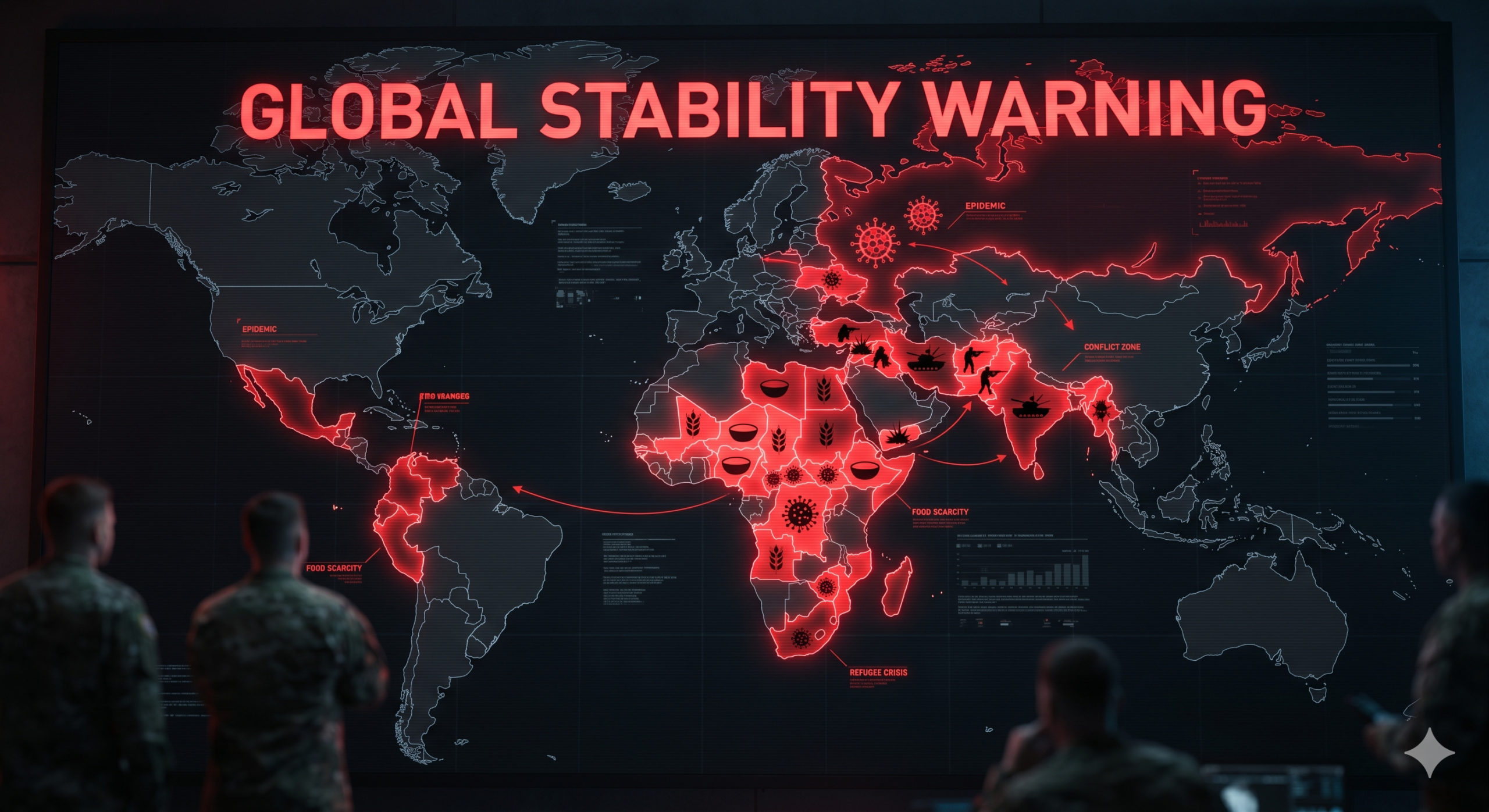
As of May 15, 2026, the GCI Master Index stands at 56/100 , placing the global system within a historical equilibrium range. While no “birth pang” convergence pattern has been detected this cycle, specific sectors exhibit high-intensity stress. Disease Activity has reached a Critical status (87.5), driven by a lethal Ebola outbreak in the Democratic Republic of Congo and emerging hantavirus concerns. Food Stress is currently Elevated (65.5), exacerbated by price spikes and the emergence of famine risks in Somalia.The primary global drivers are currently identified as Ethnic Conflict (94.3) , Disease (87.5) , and Rumors of War (70.0) . While these channels are largely operating in isolated domains, a notable intersection is occurring between active conflict corridors and grain supply disruptions, indicating a dual-vector stress point for global stability.
Sector Analysis: Primary Drivers
1. Disease Activity (Status: CRITICAL | Score: 87.5)
Disease activity represents the most immediate threat to global stability this cycle, showing a +7.5 increase in intensity.
- Ebola Outbreak: A new outbreak in the eastern Democratic Republic of Congo has resulted in 65 confirmed fatalities.
- Hantavirus: The WHO Director-General has held briefings in Madrid regarding a hantavirus outbreak, indicating international concern.
- Meningitis: In the United Kingdom, a student death and subsequent treatments at a college have been reported.
- Public Health Discourse: Recent intelligence includes a focus on the history of AIDS work and societal acceptance within religious institutions.
2. War and Conflict (Status: MONITORING | Score: 50.0)
The conflict landscape is characterized by strategic failures and persistent localized warfare.
- Middle East Tensions:
- International media are characterizing the American involvement in Iran as “Epic Fury,” labeled a strategic failure and a “debacle.”
- Iran has reportedly seized a “floating armoury” ship.
- While Lebanon and Israel have initiated new negotiations, fighting with Hezbollah continues, and Hezbollah maintains strong support in southern Lebanon following ceasefire failures.
- Ukraine Conflict:
- Massive Russian strikes on Kyiv have resulted in civilian casualties, with rescuers recovering bodies from the rubble of residential flats.
- Operational overviews for early 2026 indicate sustained high-intensity conflict.
3. Food Stress (Status: ELEVATED | Score: 65.5)
The global food supply is under significant pressure from both economic and environmental factors.
- FAO Price Spikes: The FAO Food Price Index has reached 130.7 , significantly higher than the baseline of 108.0 (2014-16 average).
- Somalia Famine Risk: UN agencies (OCHA, FAO, WFP, UNICEF) have issued a joint warning regarding a worsening hunger and malnutrition crisis in Somalia, with a formal famine risk emerging.
Secondary Indicators and Monitoring
Humanitarian and Environmental Impact
Category,Score,Status,Key Events
Humanitarian,42.9,Monitoring,”Medium-impact agricultural droughts in Angola, DRC, Gabon, Zambia, and Madagascar.”
Weather,51.0,Monitoring,”276 active US alerts (41 severe). Severe wildfires reported in Alberta, Canada.”
Seismic,20.0,Stable,”5 events of M4.5+ in 24 hours, well below the historical baseline of 13.2/day.”
Economic Stress (Status: MONITORING | Score: 48.8)
Economic indicators remain relatively stable but require continued observation.
- Volatility Index (VIX): The CBOE VIX is at 18.80 , slightly below the historical baseline of 19.5, indicating a moderate level of market fear.
- Market Reports: The WFP has highlighted specific market volatility in Pakistan as of early May 2026.
Convergence Delta and Analytical Conclusions
The current intelligence cycle identifies a Convergence Delta characterized by “Pang State” scores (≥72.5) in two specific categories: Ethnic Conflict and Disease .
Critical Insights:
- Dual-Vector Stress: Although the system is below the Active Convergence threshold, the simultaneous elevation of Ethnic Conflict and Disease suggests a heightened state of global vulnerability.
- Conflict-Food Intersection: There is a confirmed overlap where active conflict corridors are intersecting with grain supply disruptions. This “multi-vector activity” is a primary contributor to the current instability.
- Regional Instability: Sub-Saharan Africa is currently the geographic focus of triple-threat pressures: Ebola outbreaks (DRC), famine risks (Somalia), and widespread agricultural drought (Angola, Zambia, Madagascar).System Status: The Master Index of 56 confirms the system remains within the historical equilibrium range; however, the Critical status of Disease Activity and Elevated Food Stress represent significant outliers that could trigger broader convergence if they begin to amplify other categories.
I’m Wayne – and that’s our world today!