May 19, 2026 Status Summary
Executive Summary
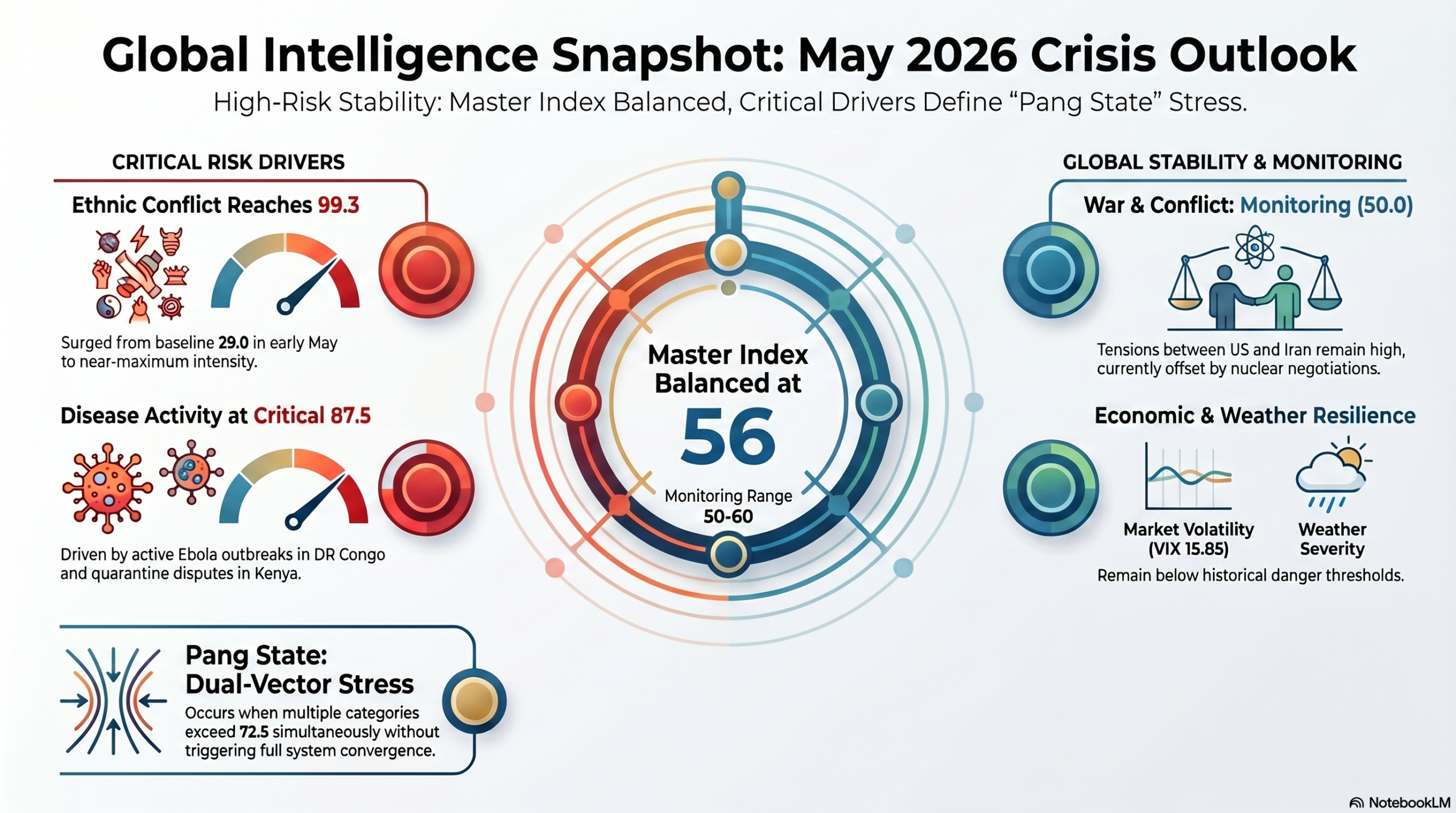
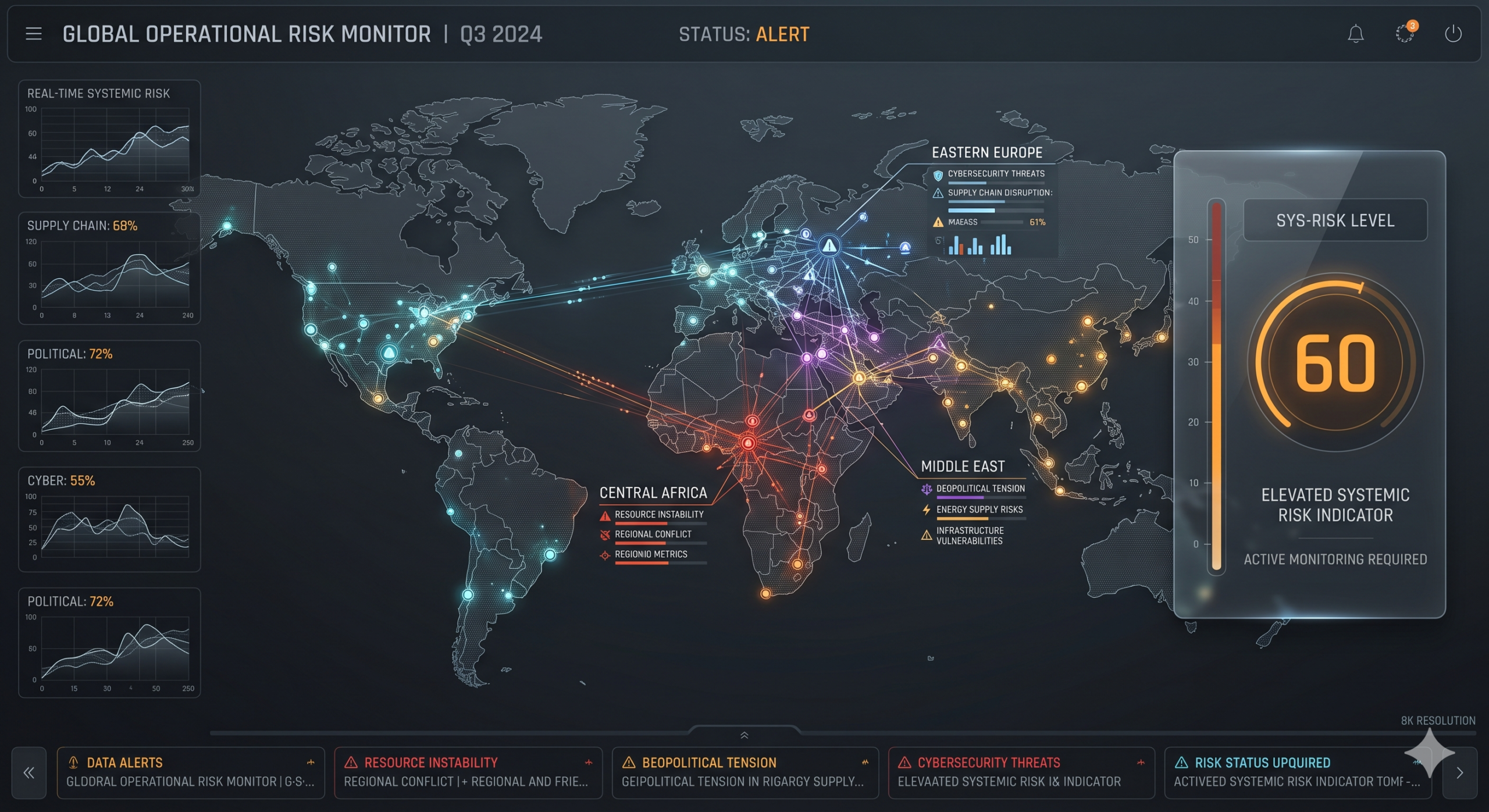
This Global Crisis Intelligence Briefing details the baseline tracking metrics for May 19, 2026, as the Global Crisis Intelligence (GCI) Master Index stands at 60 (Elevated). The data shifts this cycle are driven primarily by extreme levels of ethnic conflict, critical disease activity, and severe weather events. While the overall global index remains safely below the absolute systemic convergence threshold, a localized “Pang State” convergence has officially been reached on the ground, where ethnic conflict, disease, and weather vectors simultaneously exceed the critical 72.5 baseline.
- Biological Security: The Ebola outbreak in the Democratic Republic of Congo (DRC) has reached a critical status (87.5), with officials declaring it a Public Health Emergency of Continental Security.
- Geopolitical Volatility: High-stakes tensions between the United States and Iran persist, alongside a transformative “kill-zone” environment on the Ukrainian front lines.
- Environmental and Resource Compression: Severe weather events, including Cyclone Maila and regional droughts, are intersecting with rising food prices (FAO Index at 131.5) to compress global agricultural output and exacerbate malnutrition in vulnerable regions like Somalia.
Primary Crisis Drivers
Ethnic Conflict
- Score: 98.3
- Status: Critical
- Trend: Unchanged
Disease Activity
- Score: 87.5
- Status: Critical
- Trend: Unchanged
Weather Severity
- Score: 78.2
- Status: Active
- Trend: Downward (▼ -3.8)
Food Stress
- Score: 66.0
- Status: Elevated
- Trend: Unchanged
War and Geopolitical Conflict
The conflict sector is currently in a state of high-intensity monitoring (Index: 50.0), characterized by rapid shifts in diplomatic and military posture in the Middle East and Eastern Europe.
Middle East Tensions (Iran)
- Tactical De-escalation: Reports indicate that U.S. President Trump called off a planned strike on Iran at the request of Gulf allies. However, the administration continues to warn that the “clock is ticking” as peace progress remains stalled.
- Internal Instability: There has been a reported surge in political executions within Iran since the start of the conflict.
- Nuclear Proliferation Concerns: Media reports suggest Iran is seeking to transfer its nuclear stockpile to Russia.
- Refugee Crisis: Shifting trends in protection concerns among Afghan refugees in Iran are being monitored following recent ceasefires.
Ukraine Front Line
- Technological Transformation: Intelligence from the “kill-zone” on Ukraine’s front lines indicates that new weaponry has fundamentally transformed the nature of the war.
- Human Rights and Prisoners: Concerns are mounting for foreign nationals, including a British ex-soldier, currently imprisoned by Russia in occupied territories.
Biological Hazards and Disease Activity
With a score of 87.5 , disease activity is the most immediate critical threat to regional and continental stability.
- Ebola Outbreak (DR Congo):
- The outbreak, identified as the Bundibugyo strain, has resulted in at least 131 confirmed deaths in the Ituri region.
- The Africa CDC has officially declared the situation a Public Health Emergency of Continental Security .
- Response efforts are reportedly delayed, leading to accusations of negligence as cases and deaths rise.
- International Containment: The United States has initiated Ebola screening at airports following reports of an American citizen being infected in the DRC.
- Health Sovereignty: Emerging trends show African leaders discussing “health sovereignty” as traditional donor support fades, complicated by the simultaneous presence of Ebola and hantavirus.
Environmental and Humanitarian Impact
Weather and humanitarian sectors are showing significant stress, particularly where they intersect with food security.
Severe Weather and Seismic Events
- Tropical Cyclone Maila: Severe impacts reported in Papua New Guinea (Situation Report No. 08).
- U.S. Weather Activity: NOAA has 428 active alerts, including 76 severe warnings. Severe flood warnings are currently in effect for multiple counties in Missouri (Bates, Cass, Henry, and Johnson).
- Seismic Activity: Relatively stable at 31.0, with 8 events of M4.5+ in the last 24 hours, which is below the historical baseline of 13.2.
Humanitarian Compression
- Agricultural Drought: GDACS has issued Orange alerts for medium-impact agricultural droughts across 368,993 km² in Angola, DRC, Republic of Congo, Gabon, and Zambia, as well as 281,056 km² in Madagascar.
- Malnutrition: Somalia is facing a severe acute malnutrition burden across multiple districts and regions throughout 2026.
- Displacement: In India, Bengali Muslims face increasing persecution and displacement linked to citizenship disputes.
Economic and Food Stress
The global economy is exhibiting signs of “market jitters” (Index: 48.0) as resource scarcity increases.
- Food Pricing: The FAO Food Price Index has reached 131.5 , significantly higher than the baseline of 108.0.
- Currency Volatility: The Thai baht is drifting toward 33 per U.S. dollar, reflecting intensifying global market instability.
- Civil Unrest Linked to Costs: Nationwide protests have erupted in Kenya in response to soaring fuel prices.
- Market Fear: The CBOE VIX stands at 18.35, remaining near the historical baseline of 19.5 but subject to monitoring.
Convergence Delta Analysis
The GCI reports a critical Convergence Delta in Pang State, where three specific channels—Ethnic Conflict, Disease, and Weather—have simultaneously surpassed the 72.5 threshold.Key Convergence Observations:
- Atmospheric-Agricultural Compression: Weather severity and food stress channels are intersecting, meaning atmospheric events are directly compressing agricultural output and driving price spikes.
- Conflict-Supply Intersection: Active conflict corridors are increasingly overlapping with grain supply disruptions, creating a multi-vector crisis that threatens both physical security and caloric intake for affected populations.
- Multi-Vector Activity: 5 out of 8 monitoring categories have verified headlines this cycle, indicating broad-based global instability despite the Master Index remaining at 60.
I’m Wayne – and that’s our world today!